Bioimpacts. 16:30810.
doi: 10.34172/bi.30810
Original Article
Designing a multi-epitope vaccine against dengue virus-2 using in silico tools for expression in plant systems
Marzieh Shokoohi Data curation, Formal analysis, Investigation, Methodology, Resources, Validation, Visualization, 1, 2, * 
Ara Manteghi Tafreshi Investigation, Visualization, Writing – original draft, 2
Milad Mokarami Investigation, Visualization, Writing – original draft, 3
Saeedeh Akhavan Visualization, Writing – review & editing, 4
Reza Mohammadhassan Conceptualization, Funding acquisition, Methodology, Project administration, Supervision, Validation, Visualization, 2, 5, *
Author information:
1Department of Life Sciences Engineering, Faculty of New Sciences & Technologies, University of Tehran, Tehran, Iran
2Amino Techno Gene Private Virtual Lab, Tehran, Iran
3Student Research Committee, Faculty of Medicine, North Khorasan University of Medical Sciences, Bojnurd, Iran
4Department of Biology, School of Basic Sciences, Science and Research Branch, Islamic Azad University (IAU), Tehran, Iran
5Department of Biochemistry, Biomedical School, University of Otago, Dunedin, New Zealand
Abstract
Introduction:
Dengue virus (DENV), transmitted by Aedes mosquitoes, remains a serious global health threat with an increasing incidence, largely due to its complex epidemiology and the impact of climate change. DENV belongs to the Flaviviridae family, comprising four serotypes (DENV-1 to DENV-4). The high mutation rate of DENV and the risk of antibody-dependent enhancement (ADE) complicate the development of a vaccine. This study aims to design a multi-epitope vaccine against DENV, with a focus on DENV-2, the strain associated with severe symptoms.
Methods:
First, the genome of DENV-2 was analyzed and vaccine candidate proteins were identified by examining properties such as immunogenicity, toxicity, and allergenicity. The secondary and tertiary structures of the vaccine were predicted and validated, and the vaccine interaction with MHC receptors was analyzed through docking. The stability and flexibility of the vaccine were also evaluated by molecular dynamics simulation. Finally, the vaccine gene sequence was optimized for expression in Nicotiana benthamiana and cloned into the pBI121 vector.
Results:
In this study, four proteins were selected from the initial 10 proteins after eliminating those that were allergens, toxins, or had homology to human or mouse proteins. Finally, protein 3 was identified as the source antigen for epitope prediction and vaccine construction. This highly immunogenic, non-toxic, and non-allergenic protein, located in the cytoplasm, was used to design a multi-epitope vaccine that includes selected epitopes, an IL-12 adjuvant, and a His tag. The designed vaccine consisted of 380 amino acids, exhibited a suitable stability index, and possessed a valid three-dimensional structure, with 95.4% of the amino acids located in the preferred region of the Ramachandran map. Docking and dynamic simulations demonstrated a stable interaction between the vaccine and MHC-I and MHC-II receptors. Also, the vaccine gene sequence was cloned into the pBI121 vector for optimal expression in N. benthamiana with a codon compatibility index of 0.78 and a GC content of 50.53%.
Conclusion:
This study demonstrates the potential of computational approaches for developing targeted vaccines against dengue fever. Additionally, molecular farming offers a promising, safe, and cost-effective method for large-scale production of vaccines. Future research should focus on preclinical and clinical trials to validate the safety and efficacy of the vaccine.
Graphical Abstract
Keywords: Dengue fever, Dengue virus 2, Vaccine development, Multi-epitope vaccine, Molecular farming
Copyright and License Information
© 2026 The Author(s).
This work is published by BioImpacts as an open access article distributed under the terms of the Creative Commons Attribution Non-Commercial License (
http://creativecommons.org/licenses/by-nc/4.0/). Non-commercial uses of the work are permitted, provided the original work is properly cited.
Funding Statement
Not applicable.
Introduction
Dengue fever (DF), a significant public health concern, is caused and transmitted by the dengue virus (DENV) and Aedes mosquitoes, respectively. DF is classified as a neglected tropical infection. Climate change can intensify the prevalence of DENV and infect millions of people annually in tropical and subtropical regions.1-3 The symptoms of DENV infection include fever, myalgia, cephalalgia, arthralgia, and potentially a medical emergency, such as hemorrhagic fever, which can lead to Dengue Hemorrhagic Fever (DHF) and Dengue Shock Syndrome (DSS) in severe cases.4,5
DENV, as a single-stranded RNA virus from the Flaviviridae family, including arthropod-transmitted viruses, can infect humans.6 There are 47 strains of DENV divided into four serotypes (DENV-1 to 4), with minor antigenic differences.7 Since DENV, including several strains and serotypes, can select and bind to many receptors on different cell types.8 DENV is spherical, with a diameter of 40-50 nm. The virus contains positive single-stranded RNA with a 5-methyl cap and a single open reading frame.9
In the initial step of infection, DENV binds dermal macrophages and dendritic cells, then spreads to lymph nodes and other organs through the cells. Viremia takes at least 10 to 12 days before clinical symptoms appear. Mosquitoes can be infected during this viremic state and transmit the virus to other potential hosts.10 Aedes aegypti and Aedes albopictus are two primary DENV vectors. DENV is transmitted in two cycles: sylvatic (in wild animals) and human. The sylvatic cycle involves non-human primates, specifically a monkey-Aedes-monkey cycle, in certain regions, such as Southeast Asia and West Africa.2,11
DENV binds to a host cell and enters the cell through the process of endocytosis. The virus enters the cell, merges with the endosomal membrane, and is discharged into the cytoplasm. The virus disassembles and releases the viral genome. The ribosome machinery of the host cell translates viral RNA (vRNA) into a single polypeptide, which is cleaved into 10 proteins. Additionally, DENV utilizes the host cell machinery to replicate; therefore, the virus can overcome various challenges posed by the host immune system.2 The virus is assembled on the surface of the endoplasmic reticulum (ER) when newly synthesised RNA and structural proteins bud off from the ER. The trans-Golgi network (TGN) converts immature viruses into an infectious form. Thus, the host cell releases a mature virus to infect other cells.10
According to the challenges posed by the complex pathogenesis, potential antibody-dependent enhancement (ADE) effects, and the high mutation rate of DENV, the development of a DENV vaccine is crucial. Additionally, the mutability of DENV can lead to the emergence of new serotypes over time. For instance, the emergence of new DENV-3 and DENV-2 serotypes highlights the ongoing challenges of severe prevalence caused by the quick evolution of DENV; thus, effective vaccine strategies are indispensable.12,13 The complex pathogenesis of DENV and its influence on immune reinforcement are crucial challenges to developing an efficient DENV vaccine. Most DENV vaccines are still in the trial stages; although some diminished live tetravalent DENV vaccines are licensed.2
DENV-2 has re-emerged with evolving transmission patterns and multiple genetic lineages across various parts of the world, particularly in Africa and South America.14,15 For instance, recent molecular surveillance in East Africa has identified two imported Cosmopolitan genotype lineages of DENV-2, likely introduced from Asia and now circulating in that region.16 Likewise, Brazil has reported several introductions and widespread dissemination of these lineages, illustrating how viral evolution links across continents.17 This global trend of gene flow, geographic connections, vector control challenges, and increased international travel has complicated the dengue burden both regionally and worldwide. Consequently, developing an effective DENV-2 vaccine is a vital scientific objective and a public health priority.15,18
The initial life-diminished tetravalent DENV vaccines, Dengvaxia (Sanofi) and TAK-003 (Takeda), have been associated with numerous adverse effects. In 2023, Takeda withdrew its candidate DENV vaccine from consideration for FDA licensing. Many documents from current vaccine trials report significant side effects, including cephalalgia, asthma, and urticaria.19,20 A clinical trial involving pregnant women revealed other adverse events, such as abortion, voluntary abortion, and fetal demise. Furthermore, it was found that these vaccines offer limited protection against the DENV-2 strain.21 Recent advancements in candidate DENV vaccines demonstrate that developing a new epitope vaccine can be highly effective, particularly against DENV-2. Thus, the computational study aims to design a novel multi-epitope vaccine against DENV-2 strains for production in plant systems. In this study, vaccine design was based on reverse vaccinology and bioinformatics tools. By analyzing the genome structure of dengue virus type 2 and predicting B and T epitopes, a multi-epitope construct was designed, including selected epitopes, IL-12 adjuvant, and a His purification tag, which was examined and confirmed for immunogenicity, non-allergenicity, and non-toxicity.
Materials and Methods
A schematic representation of the stepwise vaccine structure and validation process used in this study is depicted in Fig. 1, aimed at increasing methodological transparency and reproducibility of our computational method.
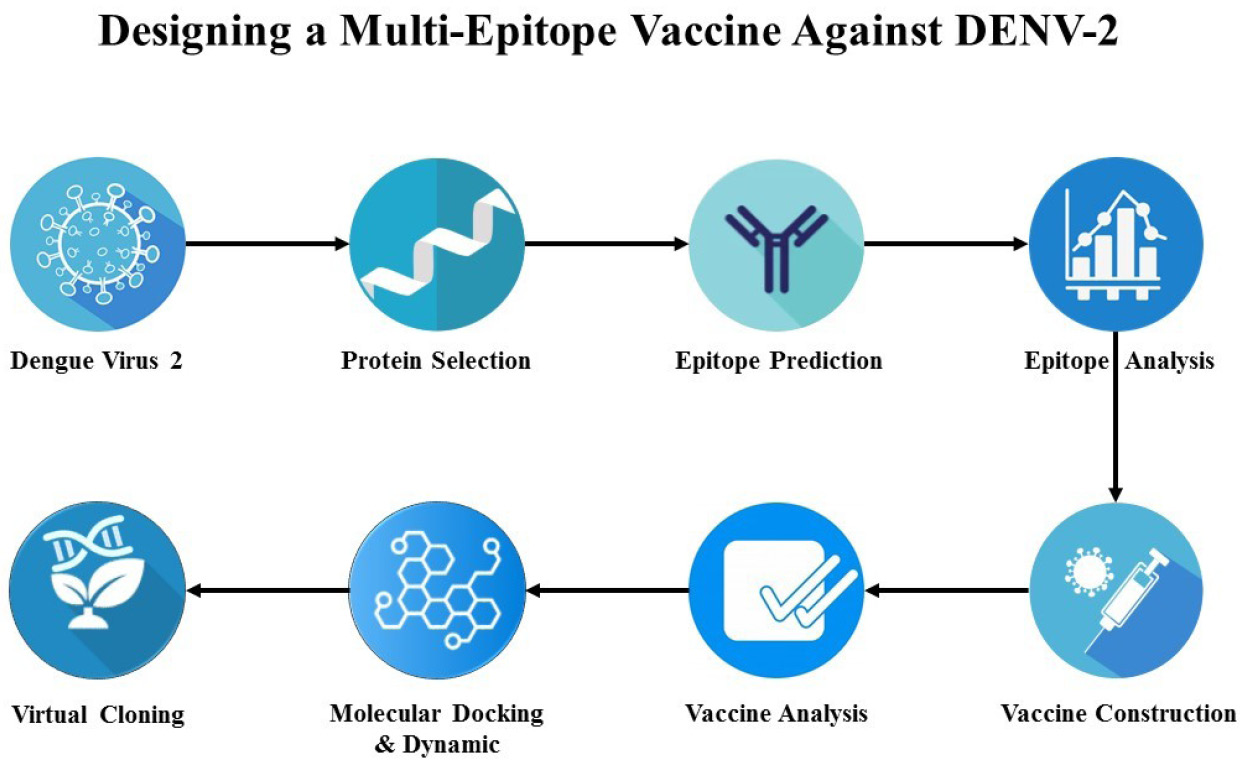
Fig. 1.
Schematic representation of the computational vaccine design workflow used in this study. The pipeline includes DENV-2 protein selection, epitope prediction and analysis, vaccine construct design, structural modeling, docking and dynamics simulation, vaccine evaluation, and virtual cloning.
.
Schematic representation of the computational vaccine design workflow used in this study. The pipeline includes DENV-2 protein selection, epitope prediction and analysis, vaccine construct design, structural modeling, docking and dynamics simulation, vaccine evaluation, and virtual cloning.
Target protein selection and preparation
The complete genome sequence of DENV-2 (NCBI Reference Sequence: NC_001474.2) was analyzed using the reference strain 16681. To identify potential coding regions, the NCBI ORF Finder22 was used with a minimum ORF length cutoff of 300 nucleotides, ensuring that only sufficiently long open reading frames were selected for downstream analyses.
Following ORF identification, the subcellular localization of the encoded proteins within human host cells was predicted using the Virus-mPLoc server.23 This tool applies a multi-label learning approach to predict multiple possible subcellular localizations, which is important because the site of protein expression within the host can strongly influence immune recognition.
To further characterize the candidate proteins, SignalP version 6.024 was employed with default parameters to detect signal peptides. Signal peptide predictions are critical in vaccine design as they help identify proteins secreted or targeted to the host cell surface, which are generally more accessible to immune surveillance.
Allergenicity filtering. Allergenic proteins were detected and removed using the AlgPred server.25 Three complementary prediction methods were applied under default parameters: (i) a BLAST tool-based ARP (Allergen Representative Protein) search, (ii) an SVM classifier based on amino acid composition (ACC), and (iii) an SVM classifier based on dipeptide composition (DC). Only proteins predicted as non-allergens by all three methods were retained, thereby minimizing the risk of false negatives and ensuring the exclusion of allergenic proteins.
Host homology filtering. To prevent autoimmunity and cross-reactivity, candidate proteins were analyzed using the BLAST tool26 against the complete human and mouse proteomes. Default parameters were applied, and proteins with significant similarity ( ≥ 30% identity over ≥ 70% coverage) to host proteins were excluded from further analyses.
Antigenicity prediction. The antigenicity of each non-allergenic, non-host-homologous protein was assessed using VaxiJen v2.0.27 VaxiJen uses an alignment-independent approach based on the auto-cross covariance (ACC) transformation of protein sequences. The “virus” model was applied with the default threshold of 0.40; proteins scoring ≥ 0.40 were considered antigenic and selected for epitope prediction.
Toxicity prediction. Toxicity was evaluated using the ToxinPred server.28 The SVM (Swiss-Prot) prediction model with default thresholds was employed to classify peptides as toxic or non-toxic. Additionally, the motif-based module of ToxinPred was applied using an E-value cutoff of 10 and an SVM threshold of 0.0 to detect potentially toxic motifs. Only peptides consistently classified as “Non-Toxin” by all models were retained.
Transmembrane topology analysis. Finally, the candidate proteins were examined for the presence of transmembrane helices using TMHMM v2.0.29 Proteins or epitopes predicted to be buried within transmembrane domains were excluded, as such epitopes are typically inaccessible to host immune surveillance. Only soluble or exposed regions were retained for vaccine design.
Collectively, these sequential filters—allergenicity, host homology, antigenicity, toxicity, and transmembrane topology—ensured that only safe, antigenic, non-toxic, and non-host homologous proteins/epitopes were forwarded to the next stage of epitope prediction and vaccine construct assembly.
Multi-epitope vaccine design and epitope selection criteria
The IEDB server was utilized with default parameters to systematically predict epitopes for all HLA alleles in the protein with the highest immunogenicity score. To ensure robustness and reproducibility, explicit selection criteria were applied. Antigenicity was evaluated using VaxiJen v2.0 (virus model) with a threshold of ≥ 0.40. Strong MHC-binding affinity was required: epitopes with IC50 ≤ 500 nM or percentile rank ≤ 1% were selected for MHC-I, and epitopes with IC50 ≤ 1000 nM or within the top 10% were selected for MHC-II. Allergenicity was excluded using AlgPred, where epitopes had to be negative in all three methods (BLAST-ARP, SVM-ACC, and SVM-DC). Toxicity was filtered using ToxinPred with the SVM (Swiss-Prot) model and the motif-based module (E-value ≤ 10, SVM score 0.0); only epitopes consistently predicted as “Non-Toxin” were retained. To avoid autoimmune cross-reactivity, epitopes showing significant similarity to human or mouse proteins ( ≥ 30% identity across ≥ 70% coverage) in BLAST were discarded. Furthermore, only epitopes with ≥ 90% conservancy among representative DENV-2 sequences were included in the final construct.
The vaccine design was constructed by linking the selected epitopes using flexible linkers (GPGPG or KK). An adjuvant, Interleukin-12 (IL-12; Accession No. AAB37425.2), was incorporated to enhance immunogenicity, joined via a PAPAP linker. A His-tag was added at the C-terminus to facilitate purification in Nicotiana benthamiana, a model plant for recombinant protein expression. The final construct was then validated for its antigenicity, allergenicity, and toxicity using the aforementioned tools.
Physicochemical characteristics
The physical and chemical characteristics of the candidate vaccine were analyzed using the ProtParam tool.30 Parameters, including theoretical pI, molecular weight, total numbers of negatively charged residues (Asp + Glu) and positively charged residues (Arg + Lys), grand average of hydropathicity (GRAVY), the aliphatic index, and the instability index, were predicted and analyzed.
Secondary and tertiary structures
The Prabi server31 and SWISS-MODEL32 were respectively utilized with default parameters to predict the secondary and tertiary structures of the candidate vaccine sequence. The top template was Q2PE76.1.A (AlphaFold DB model of IL12B_BUBCA, Bubalus carabanensis), with sequence identity 72.41% and template coverage corresponding to residues 264–379. Subsequently, the Z score was calculated by ProSA-web.33 The precision of the predicted protein structure was analyzed using the Ramachandran plot. The PDB file containing the predicted tertiary structure of the vaccine protein was analyzed using the MolProbity server to confirm the three-dimensional structure and assess its quality.
Molecular docking and NMA-based dynamics simulation
Molecular docking was performed with the HDOCK server34 using the designed multi-epitope vaccine as ligand and experimentally solved MHC structures as receptors. For MHC class I, we selected HLA-A*02:01 (PDB ID: 5YXU) because of its wide representation in immunological studies and the availability of a high-quality crystal structure; for MHC class II, we used HLA-DRB1 (PDB ID: 4MD4) as a structural representative of the DRB1 family. The use of experimentally resolved PDB templates facilitates reproducibility and allows us to map peptide-binding grooves and contact networks with confidence.
Epidemiological data indicate that certain DRB1 alleles — notably HLA-DRB1*09:01 — are associated with reduced progression to severe dengue (DHF→DSS) in DENV-2 cohorts, highlighting the biological relevance of allele-specific investigation.35 Because an experimentally determined PDB for DRB109:01 is not available, a reliable allele-specific structural analysis requires homology modelling of the DRB109:01 β-chain followed by model validation. To avoid introducing unvalidated receptor models in the current manuscript, we used 4MD4 as an experimentally derived scaffold for initial structural docking and interaction mapping.
To gain further insights into the stability and molecular basis of vaccine–MHC binding, the docked complexes were analyzed using the ProteinTools web server.36 Hydrogen bond analysis was performed by applying standard geometric criteria: a donor–acceptor distance of ≤ 3.5 Å and a donor–H–acceptor angle of ≥ 120°. The vaccine construct–MHC-I (PDB ID: 5YXU, HLA-A*02:01) and vaccine construct–MHC-II (PDB ID: 4MD4, HLA-DRB1) complexes were examined. ProteinTools automatically detected hydrogen bond networks and provided residue-specific interactions along with donor/acceptor atoms, interatomic distances, and DHA angles. Hydrophobic contacts were also screened using default cutoffs ( ≤ 4.0–5.0 Å between nonpolar atoms).
Molecular dynamics simulations were performed using the iMODS server,37 which applies a normal mode analysis (NMA)-based approach. Therefore, classical MD parameters such as force fields, solvent models, temperature, and simulation time are not applicable in this context. Additionally, the online server accurately predicted various dynamic parameters, including B-factor (mobility profiles), covariance map, deformability, variance, individual values, and the protein complex elastic network. The B-factor output serves as an analog to root mean square fluctuation (RMSF), providing residue-level insight into protein flexibility.
Codon optimization and in silico cloning
ExpOptimizer38 was utilized for codon optimization to express the vaccine in N. benthamiana, based on the molecular farming system. Also, Geneious Prime 2023.0.1 Software 39 was employed to insert and clone virtually the entire vaccine construction into the pBI121 vector, which would be transferred and expressed in plant cells via the Agrobacterium-mediatedgene transfer system.
Results
Epitope prediction
The DENV-2 genome is a single-stranded RNA with a length of 10,723 nucleotides (nt) and a 46% GC content. It identified 11 ORFs (Table 1). No signal peptides were detected.
Table 1.
Characteristics of the identified ORFs
|
Protein name
|
Length (# amino acids)
|
Predicted subcellular localization in human host cell
|
| Protein-1 |
3391 |
Viral capsid
Host endoplasmic reticulum |
| Protein-2 |
168 |
Host cell membrane
Host endoplasmic reticulum |
| Protein-3 |
110 |
Host cytoplasm |
| Protein-4 |
192 |
Host cell membrane |
| Protein-5 |
101 |
Host cell membrane
Host cytoplasm |
| Protein-6 |
102 |
Host cytoplasm |
| Protein-7 |
160 |
Host cytoplasm |
| Protein-8 |
105 |
Host cytoplasm |
| Protein-9 |
189 |
Host endoplasmic reticulum |
| Protein-10 |
228 |
Host endoplasmic reticulum |
| Protein-11 |
184 |
Host cell membrane
Host endoplasmic reticulum |
After that, allergenic proteins were removed from the study. None of the 10 proteins showed significant similarity with the host proteins. Moreover, proteins that lacked sufficient immunogenicity and antigenicity were excluded from further analysis. Among the identified ORFs, four proteins met the initial criteria of adequate antigenicity and immunogenicity, low similarity to host proteins, and non-allergenic properties. Subsequently, two of these proteins were identified as non-toxic. However, proteins with predicted transmembrane helices were excluded due to potential folding and expression challenges.
Protein-3, which is localized in the host cytoplasm, exhibited the highest antigenicity score (0.702) among all non-toxic, non-allergenic candidates. Its accessible cytoplasmic location, combined with favorable immunological characteristics and the absence of signal peptides or allergenic motifs, made it the most promising antigen for multi-epitope vaccine design. Therefore, Protein-3 was selected for epitope prediction and vaccine construction (Table S1). After all target antigen-associated epitopes were identified, each epitope was assessed for toxicity, antigenicity, and allergenicity (Table 2).
Table 2.
The characteristics of the selected epitopes
|
|
|
Epitope sequence
|
Antigenicity
|
Toxicity
|
Allergenicity
|
| B cell |
1 |
DAGRRS |
0.3969 |
Non-Toxin |
No-Evidence |
| 2 |
GTPMSIFDNGHPFPRP |
0.0121 |
Non-Toxin |
No-Evidence |
| MHC I |
1 |
CLNIGVTNV |
2.5179 |
Non-Toxin |
No-Evidence |
| 2 |
FSRKPISFA |
1.628 |
Non-Toxin |
No-Evidence |
| 3 |
LAIAVRDTF |
1.562 |
Non-Toxin |
No-Evidence |
| 4 |
TVAWLAIAVR |
1.5565 |
Non-Toxin |
No-Evidence |
| 5 |
VFSRKPISF |
1.2657 |
Non-Toxin |
No-Evidence |
| 6 |
RSFFVFSRK |
1.2521 |
Non-Toxin |
No-Evidence |
| 7 |
FAMVAATTV |
1.0787 |
Non-Toxin |
No-Evidence |
| 8 |
MVAATTVRM |
0.966 |
Non-Toxin |
No-Evidence |
| 9 |
VTNVVATAY |
0.6223 |
Non-Toxin |
No-Evidence |
| MHC II |
1 |
PISFAMVAATTVRMA |
1.3754 |
Non-Toxin |
No-Evidence |
| 2 |
KPISFAMVAATTVRMA |
1.3785 |
Non-Toxin |
No-Evidence |
| 3 |
PISFAMVAATTVRMAM |
1.2918 |
Non-Toxin |
No-Evidence |
| 4 |
PNPRSFFVFSRKPISFAM |
1.2086 |
Non-Toxin |
No-Evidence |
| 5 |
RKPISFAMVAATTVRMA |
1.1581 |
Non-Toxin |
No-Evidence |
Vaccine construction
Adjuvant was attached at the C-terminus of the candidate vaccine. The His-tag, containing six histidine residues, was added to the C-terminus of the adjuvant for effective purification. The sequence length of the designed vaccine candidate includes 380 amino acids (Fig. 2A). The toxicity, antigenicity, and allergenicity of the designed vaccine construction were analyzed. The results showed no toxin peptide sequences in the vaccine construction. Also, the construction was non-allergic. The antigenicity score was 0.7345, a favourable score.
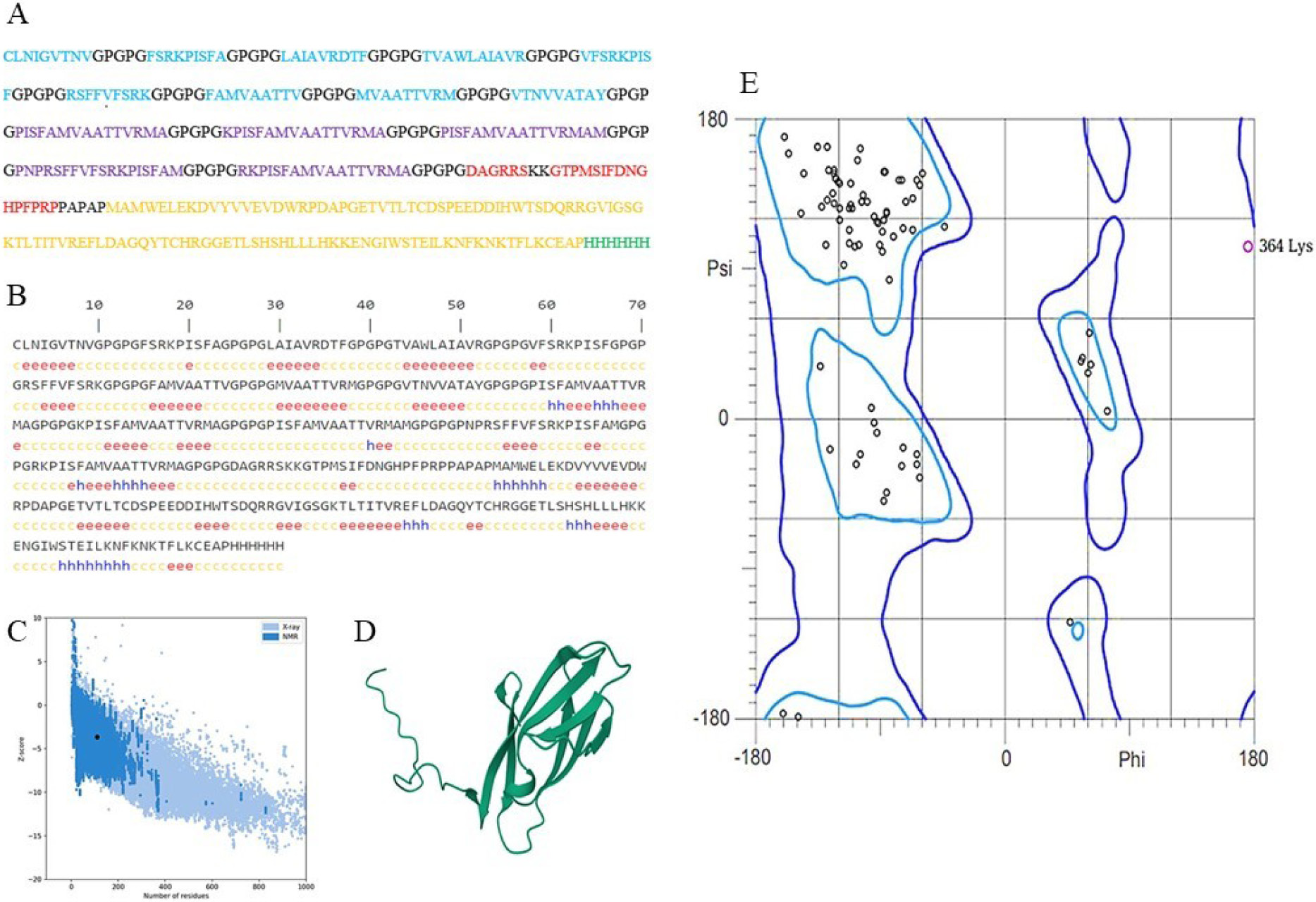
Fig. 2.
Structure and validation of the designed multi-epitope vaccine construct. A) The amino acid sequence of the vaccine construction contains linkers (Black), adjuvant (yellow), His-tag (Green), epitopes for MHC-II (Purple), MHC-I (Blue), and B cells (Red). B) The secondary structure of the designed vaccine. C) Analysis of the 3D model of the candidate vaccine construction. D) 3D model of the candidate vaccine construct. E) Ramachandran plot analysis for candidate DENV-2 vaccine. Model template: SWISS-MODEL reported Q2PE76.1.A (AlphaFold DB model of IL12B_BUBCA; seq identity 72.41%; template range 264–379).
.
Structure and validation of the designed multi-epitope vaccine construct. A) The amino acid sequence of the vaccine construction contains linkers (Black), adjuvant (yellow), His-tag (Green), epitopes for MHC-II (Purple), MHC-I (Blue), and B cells (Red). B) The secondary structure of the designed vaccine. C) Analysis of the 3D model of the candidate vaccine construction. D) 3D model of the candidate vaccine construct. E) Ramachandran plot analysis for candidate DENV-2 vaccine. Model template: SWISS-MODEL reported Q2PE76.1.A (AlphaFold DB model of IL12B_BUBCA; seq identity 72.41%; template range 264–379).
Physicochemical analysis provided valuable insights into the construction of the vaccine. The molecular weight and theoretical pI were, respectively, 39564.68 Da and 10.14. The number of positively charged residues (38) was higher than negatively charged residues (22). According to the instability index (27.26), the designed construction is stable. The aliphatic index and GRAVY were 62.39 and -0.104 (Table 3).
Table 3.
Physicochemical properties of the vaccine candidate
|
Property
|
Value
|
| Molecular weight |
39564.68 |
| Theoretical pI |
10.14 |
| Total number of negatively charged residues (Asp + Glu) |
22 |
| Total number of positively charged residues (Arg + Lys) |
38 |
| The instability index |
27.26 (stable) |
| Aliphatic index |
62.39 |
| Grand average of hydropathicity (GRAVY) |
-0.104 |
Secondary and tertiary structures
The Prabi server predicted the secondary structure of the designed vaccine and revealed 8.16% helix content (Table 4; Fig. 2B). The SWISS-MODEL site predicted the tertiary structure of the vaccine candidate (Fig. 2C). Furthermore, ProSA-web was used to assess the 3D model of the vaccine construct, producing an initial model (Z score = -3.35; Fig. 2D).
Table 4.
Predicted secondary structure composition of the designed vaccine construct
|
Secondary structure type
|
Percentage (%)*
|
Count
|
| Alpha helix (Hh) |
8.16 |
31 |
| Extended strand (Ee) |
30.53 |
116 |
| Random coil (Cc) |
61.32 |
233 |
* Percentages are calculated based on the total length of the vaccine protein (380 amino acids).
Moreover, the Ramachandran diagram illustrates the distribution of amino acids in various positions along the conformation of the protein backbone. The results showed that 95.4% of the amino acids are in the preferred region of the Ramachandran chart, demonstrating an appropriate conformational arrangement. Moreover, 99.1% of the amino acids were detected in the permitted range, indicating that reasonable deviations from ideal conformations are possible (Fig. 2E). The results offered important information about the reliability and quality of the tertiary structure of the candidate vaccine protein. Generally, the vaccine construct is structurally stable and functional due to the favorable and permitted conformations that most amino acids exhibit.
Molecular docking
Among 100 generated models, the docked model was selected based on the lowest ligand RMSD and the highest docking score (-252.66 kJ/mol for 5YXU and -286.03 kJ/mol for 4MD4). Model 1 was introduced as the well-docked vaccine-receptor complex. The model showed that the vaccine can engage with the MHC (Fig. 3).
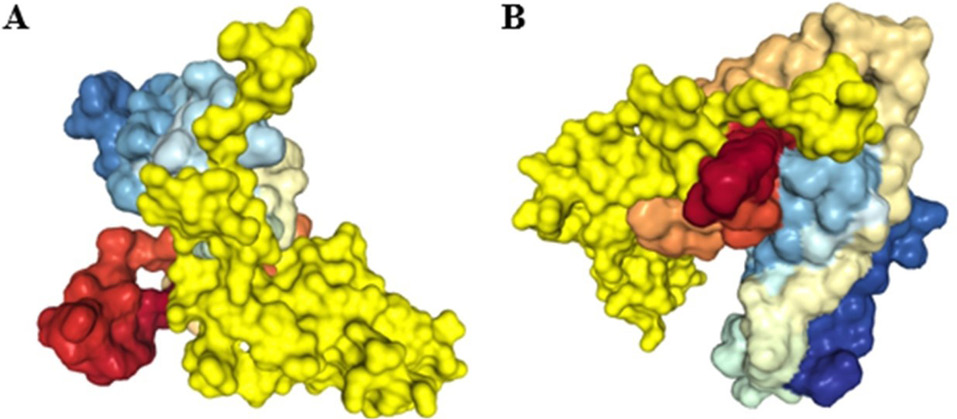
Fig. 3.
Docked complexes of the designed multi-epitope vaccine construct with MHC receptors, obtained using the HDOCK server. (A) Vaccine construct (yellow) docked to MHC class I (PDB ID: 5YXU, HLA-A*02:01). (B) Vaccine construct (yellow) docked to MHC class II (PDB ID: 4MD4, HLA-DRB1). In both panels, the receptor molecules are shown in ribbon representation with distinct colors for each chain, while the ligand (vaccine) is highlighted in yellow for clarity.
.
Docked complexes of the designed multi-epitope vaccine construct with MHC receptors, obtained using the HDOCK server. (A) Vaccine construct (yellow) docked to MHC class I (PDB ID: 5YXU, HLA-A*02:01). (B) Vaccine construct (yellow) docked to MHC class II (PDB ID: 4MD4, HLA-DRB1). In both panels, the receptor molecules are shown in ribbon representation with distinct colors for each chain, while the ligand (vaccine) is highlighted in yellow for clarity.
The interaction analysis demonstrated that the designed vaccine forms multiple hydrogen bonds and stabilizing contacts with both MHC-I and MHC-II molecules.
For the MHC-I complex (5YXU), a total of 9 hydrogen bonds were identified, with interatomic distances ranging from 2.1 Å to 3.4 Å and angles from 125° to 168°. Notably, residues Arg372 and Tyr25 of HLA-A*02:01 formed strong hydrogen bonds with the vaccine construct, indicating a firm anchoring within the peptide-binding groove. Hydrophobic contacts involving Thr106 and Tyr32 further stabilized the interaction.
For the MHC-II complex (4MD4), 12 hydrogen bonds were observed, with distances between 2.7 Å and 3.3 Å and angles from 133° to 174°. Key stabilizing residues included Arg140, Arg146, and His177, which established multiple bonds with acidic residues of the construct, creating a strong electrostatic complementarity. Additional hydrogen bonds such as His425–Glu47 and Gln379–Asn69 further reinforced the interaction.
Collectively, these hydrogen bond networks and hydrophobic interactions suggest that the vaccine construct is able to establish a stable and biologically plausible binding mode with both MHC-I and MHC-II molecules, providing structural support for its predicted immunogenicity.
NMA-based dynamics simulation
In the deformability plots, peaks represent regions of structural flexibility in the complexes. For 5YXU (Fig. 4A) and 4MD4 (Fig. 5A), several flexible regions were observed, indicating possible epitope accessibility.
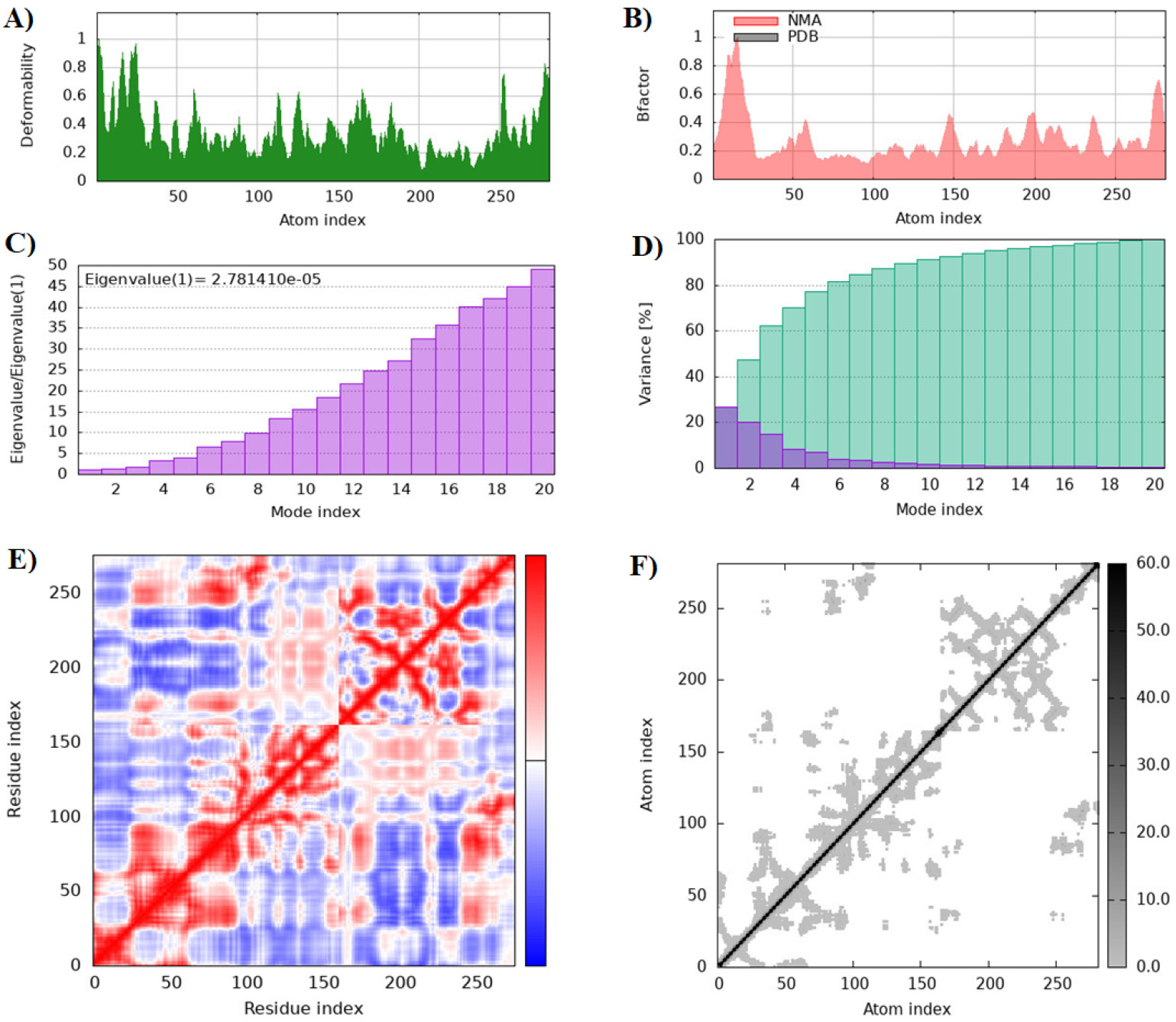
Fig. 4.
Molecular dynamics simulations of the vaccine-5YXU complex: A) Deformability; B) B-factor; C) Eigenvalues; D) Variance (purple: individual variances, green: cumulative variances); E) Covariance map (red: correlated, white: uncorrelated, blue: anti-correlated); F) Elastic network (darker grey shows more stiff regions).
.
Molecular dynamics simulations of the vaccine-5YXU complex: A) Deformability; B) B-factor; C) Eigenvalues; D) Variance (purple: individual variances, green: cumulative variances); E) Covariance map (red: correlated, white: uncorrelated, blue: anti-correlated); F) Elastic network (darker grey shows more stiff regions).
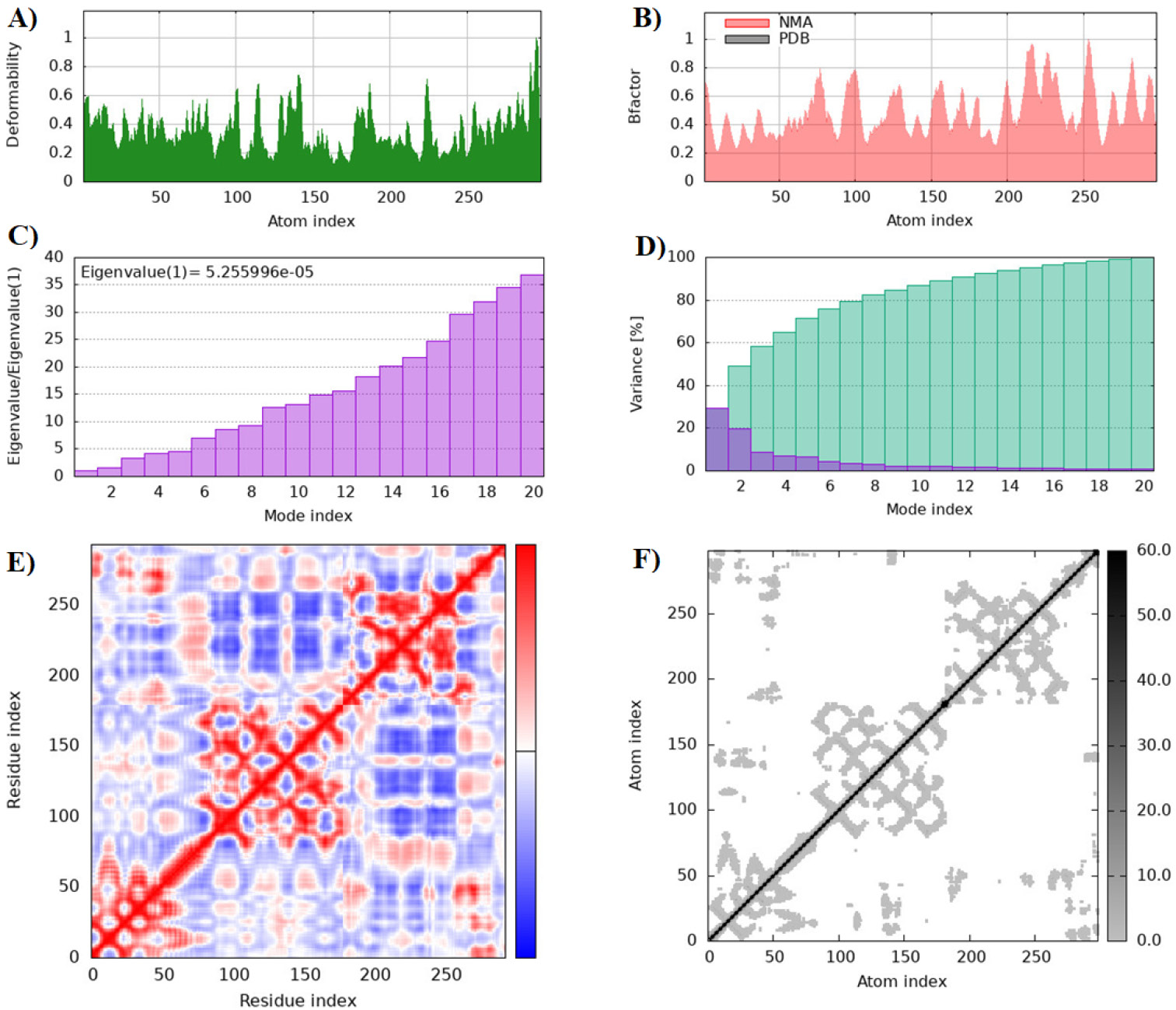
Fig. 5.
Molecular dynamics simulations of the vaccine-4MD4 complex: A) Deformability; B) B-factor; C) Eigenvalues; D) Variance (purple: individual variances, green: cumulative variances); E) Covariance map (red: correlated, white: uncorrelated, blue: anti-correlated); F) Elastic network (darker grey shows more stiff regions).
.
Molecular dynamics simulations of the vaccine-4MD4 complex: A) Deformability; B) B-factor; C) Eigenvalues; D) Variance (purple: individual variances, green: cumulative variances); E) Covariance map (red: correlated, white: uncorrelated, blue: anti-correlated); F) Elastic network (darker grey shows more stiff regions).
The B-factor plots, which are conceptually equivalent to RMSF, illustrate residue-level fluctuations. As shown in Figs. 4B and 5B, both complexes exhibit low fluctuation in the core regions, with moderate mobility in surface-exposed loops, suggesting stable complex formation.
The eigenvalues of the docked complexes were calculated as 2.781410e-05 (for 5YXU) and 5.255996e-05 (for 4MD4), indicating good overall stability and moderate stiffness of the protein complexes (Figs. 4C and 5C).
The variance plots (Figs. 4D and 5D) demonstrate the contribution of individual and cumulative modes to the overall motion, with higher variance indicating greater flexibility. Purple bars represent the variance of individual normal modes, while green bars show cumulative variance.
The covariance matrices (Figs. 4E and 5E) show mostly correlated (red) and non-correlated (white) motions, suggesting coordinated movement between key residues involved in docking.
Finally, the elastic network maps (Figs. 4F and 5F) illustrate atomic interactions as spring connections. Darker grey regions correspond to rigid segments, reflecting strong interatomic constraints and mechanical stability of the docked complexes.
Collectively, these analyses confirm the favorable binding interactions and structural stability of the vaccine–receptor complexes, supporting their potential biological relevance.
Codon optimization and in silico cloning
ExpOptimizer was used to optimize the codon usage of the final vaccine construct for expression in N. benthamiana, a plant model. The optimized sequence length was 1140, with a codon adaptation index of 0.78. The GC content of the optimized sequence was 50.53%, indicating a positive potential for expressing the candidate vaccine in N. benthamiana. The codon-adapted vaccine construction was inserted into the pBI121 vector (Fig. 6).
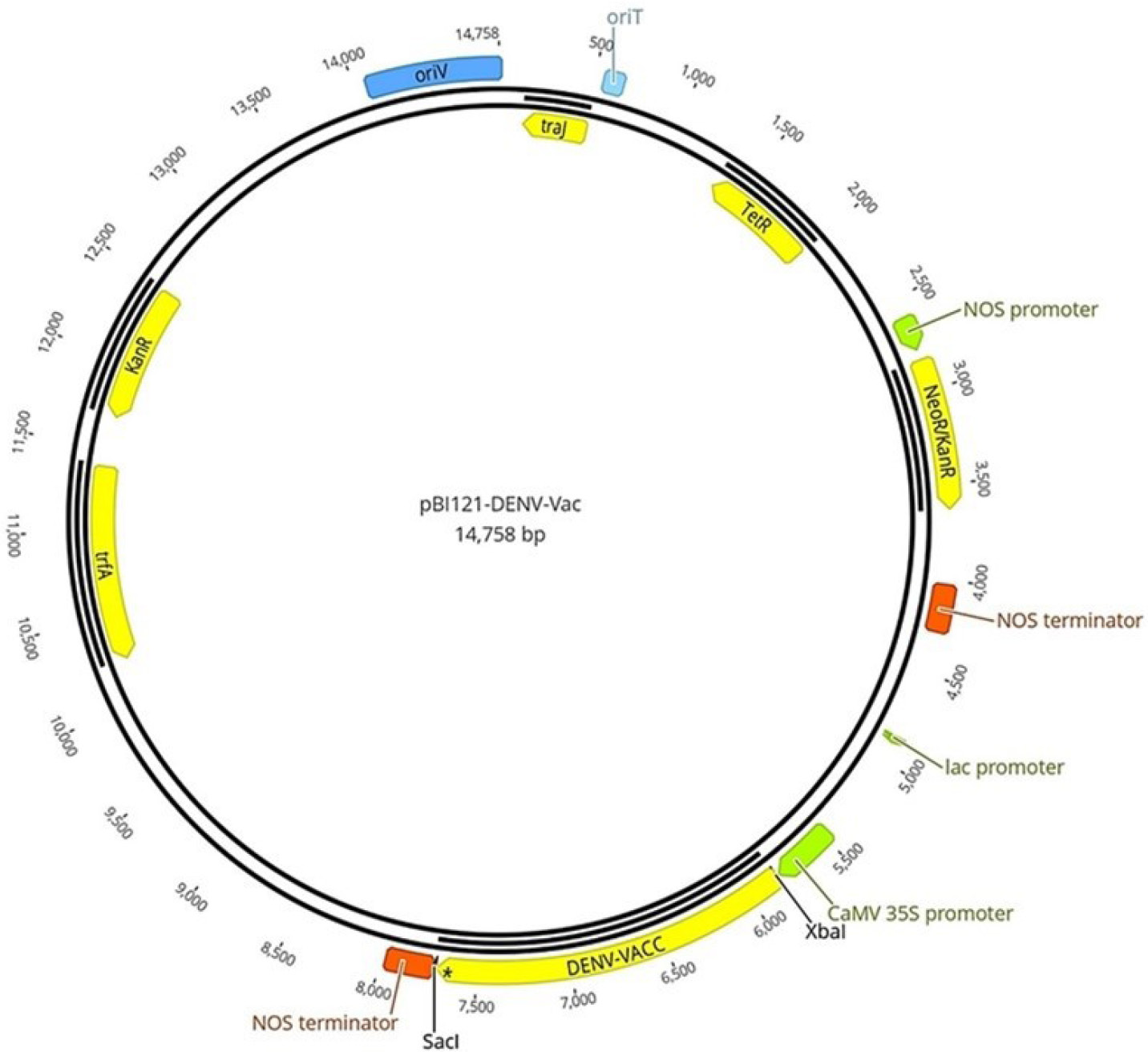
Fig. 6.
In silico cloning of the designed candidate vaccine construction. The vaccine sequence was inserted between the CaMV 35S promoter and NOS terminator for optimal expression in plant systems. The plasmid includes key elements such as Neomycin and Kanamycin resistance cassette (NeoR/KanR) for selection, lac promoter for regulation, and oriV for replication, supporting downstream molecular farming applications.
.
In silico cloning of the designed candidate vaccine construction. The vaccine sequence was inserted between the CaMV 35S promoter and NOS terminator for optimal expression in plant systems. The plasmid includes key elements such as Neomycin and Kanamycin resistance cassette (NeoR/KanR) for selection, lac promoter for regulation, and oriV for replication, supporting downstream molecular farming applications.
Discussion
Although DF is a serious risk to life, there are few effective treatments available in tropical regions, particularly in developing countries, which are the primary areas of DENV transmission. Currently, there are no antiviral therapies available for DF. Studies on antiviral agents can be lengthy and may lead to the development of resistance and an increase in viral prevalence.40 Vaccines that neutralize viruses and create a functioning immune system are an alternative to antiviral medications. However, developing a vaccine using conventional methods for any pathogen usually takes many years. Hopefully, the development of in silico methods and the availability of biological databases have simplified the identification of the most efficient epitopes, thereby decreasing the time required to design candidate vaccines.41,42 Additionally, immunoinformatics offers an in silico method for developing epitope-based vaccines, which is typically quicker and more precise, economical, and chemically stable than traditional methods, without infectious or oncogenic risks. Therefore, it is imperative to develop an efficient dengue vaccine with the fewest possible side effects to decrease the incidence of the disease.43,44
The immune response to DENV-2 is a complex process that involves both innate and adaptive immune mechanisms. Infection can activate the innate immune system, with dendritic cells and macrophages playing crucial roles in recognizing and responding to the virus. These cells release cytokines and interferons that initiate an antiviral response, aiming to control the spread of the virus.45,46
The activation of B and T cells characterizes the adaptive immune response. B cells produce specific antibodies against DENV-2, which can neutralize the virus. However, in dengue, a phenomenon known as antibody-dependent enhancement (ADE) can occur.47,48 ADE occurs when non-neutralising antibodies from a previous dengue infection with a different serotype enhance the virus entry into host cells, potentially leading to more severe disease. It is particularly relevant for DENV-2, as individuals previously infected with another serotype may experience severe outcomes during a subsequent DENV-2 infection.49
This study used immunoinformatics to develop a multi-epitope vaccine against DENV-2. A target protein was detected by ORF prediction to design a promising candidate vaccine. Many bioinformatics tools comprehensively assessed the predicted epitopes for their allergenicity, immunogenicity, and toxicity. Computational analysis confirmed the absence of a toxin region but a high antigenicity score, demonstrating a strong potential to provoke an immune response. These results indicated the protein as a significant candidate for further studies, particularly in vaccine development.
The proper adjuvants, linkers, and His-tag were used to merge the selected epitopes during vaccine construction. Attaching KK linkers to B-cell epitopes and GPGPG to specific T-cell epitopes in the study created a multi-epitope vaccine. As an adjuvant, the PAPAP linker was used to anneal the IL-12 to the N-terminal of the chimeric construction. As flexible spacers, GPGPG and KK linkers support the protein fold, making B-cell and T-cell epitopes more accessible to the immune system.50 The immune system is typically not stimulated very well by subunit vaccinations alone. Therefore, adjuvants are used in conjunction with this type of vaccine.51
IL-12 is a pro-inflammatory cytokine crucial in the immune response, primarily produced by dendritic cells, macrophages, and B cells. Additionally, IL-12 plays a significant role in linking innate immunity to adaptive immunity by inducing the differentiation of naive T cells into Th1 cells, which are crucial for targeting and eliminating intracellular pathogens.52 IL-12 stimulates the production of interferon-gamma (IFN-γ), enhancing the cytotoxicity of CD8 + T and natural killer (NK) cells. Due to the potent immunomodulatory effects of IL-12, interleukin is studied in cancer immunotherapy and autoimmune disease treatments, although its clinical use poses challenges due to potential toxicity.53
The candidate vaccine was non-allergenic and non-toxic, without 10-mer toxin peptide sequences. The antigenicity of the construction was 0.7345, a favourable score, demonstrating the strong potential to stimulate an immune response. The vaccine construction is stable with favourable characteristics, a molecular weight of 39,564.68, an aliphatic index of 62.39, and an instability index of 27.26. The secondary structure of the vaccine construction primarily consists of random coils (61.32%), with significant alpha helices and extended strands. The Ramachandran plot analysis confirms proper conformational arrangement, with 95.4% of amino acids in favoured regions, indicating structural stability.
The results from docking and molecular dynamics simulations collectively improve the predicted effectiveness of the designed vaccine construct by providing a structural understanding of its interaction with antigen-presenting molecules. The selected MHC-I (5YXU, HLA-A02:01) and MHC-II (4MD4, HLA-DRB1) molecules showed a strong binding affinity to the construct, as demonstrated by numerous hydrogen bonds and hydrophobic interactions with key residues in the peptide-binding grooves. These interactions involved stabilising contacts with Arg372 and Tyr25 in HLA-A02:01, as well as with Arg140, Arg146, and His177 in HLA-DRB1, indicating precise anchoring of the epitopes within the MHC binding sites—an essential aspect for effective CD8⁺ and CD4⁺ T-cell activation.
Furthermore, the dynamics simulations based on NMA confirmed the structural stability of the vaccine-MHC complexes. The presence of low eigenvalues and minimal residue fluctuations in the B-factor plots suggests that the core regions of the complexes maintain conformational stability under simulated physiological conditions. Additionally, the covariance and elastic network maps support the coordinated movement and mechanical stability of the docked complexes. Collectively, these analyses establish a robust computational framework to understand the interactions between the vaccine and human MHC molecules, potentially leading to a strong immune response.
T cells, particularly CD8 + cytotoxic T lymphocytes, also play a vital role by targeting and destroying infected cells. However, an overly vigorous T-cell response can contribute to the immunopathology observed in severe dengue cases, highlighting the delicate balance between effective immunity and immunopathogenesis in DENV-2 infections. Understanding these immune mechanisms is crucial for developing vaccines and therapeutic strategies against dengue.54,55 T-cells are the major elements in cell-mediated immunity and the adaptive immune system.56 They regulate innate immune cell activation, antibody responses, and the lysis of infected cells.57 Most of the T-cell epitopes displayed by MHC complexes in human and animal models were sourced from the structural proteins of DENV.58 When a T-cell epitope is located on the cell surface and detected by TCRs on T cells, it can activate the immune system within the cell.59 Pathogen-derived peptide fragments are exposed to the immune system components by binding to MHC molecules.60 Thus, cellular immunity stimulation can primarily depend on the robust binding of T-cell epitopes with MHCs.61
Finally, the ExpOptimizer server and Geneious Prime Software were respectively used for codon adaptation and in silico cloning into pBI121. The optimized DNA exhibited a favourable GC content of 50.53% and a codon adaptation index (CAI) of 0.78, indicating that the DNA sequence has a suitable proportion of favourable codons, which enhances its potential for successful expression in N. benthamiana.
Molecular farming offers numerous benefits, as it utilises plants to create recombinant proteins.62 One significant advantage is the lower cost of producing recombinant proteins in plants. Large-scale plant cultivation in greenhouses or farms can be accomplished without specific machinery such as fermenters and bioreactors.63 In contrast to bacterial systems, plants can synthesize pharmaceutical proteins that require assembly from different subunits and undergo post-translational modifications, particularly glycosylation. The ability results from the eukaryotic membrane systems of plant cells, which function similarly to those in mammalian cells, allowing for these modifications.64,65 In addition, there is no risk of zoonotic diseases, which are a potential issue in animal systems and molecular farming,66 as no common and transmissible diseases exist between plants and humans.63
Due to the favorable in silico properties of the designed vaccine, its expression from an appropriate heterologous system is essential for experimental validation downstream. Plant-based expression systems—particularly transient Nicotiana benthamiana expression—present significant advantages over conventional microbial and mammalian systems.67 These comprise low cost of production, non-presence of endotoxins, scalability, and capability of conducting eukaryotic post-translational modifications such as disulfide linkage formation and glycosylation that are frequently essential for proper folding and immunogenicity of recombinant proteins.68 In addition, plant-based expression systems are deemed environmentally friendly and biosafe for use for the rapid deployment of vaccines in outbreaks. These considerations render the plant system highly favorable for manufacturing the multi-epitope dengue vaccine candidate designed herein.69
For instance, Margolin et al. could express a high spike protein derived from SARS-CoV-2 as a recombinant vaccine in N. benthamiana.70 In another study, a self-adjuvanted and novel dual antigen subunit vaccine against Mycobacterium tuberculosis was designed, cloned into the pBI121 vector, and introduced into the genome of cucumber (Cucumis sativus) via Agrobacterium tumefaciens.71 Additionally, Goudarziasl et al. designed a multi-epitope candidate vaccine against SARS-CoV-2, which can be expressed in plants using pBI121 to produce the pharmaceutical recombinant protein.72 In a recent study, two recombinant constructs containing prostate cancer-specific protein (PAP) in the form of PAP-Fc and PAP-FcK were transferred to Nicotiana tabacum using the pB121 vector through the Agrobacterium-mediated system and then produced in this plant.73
The pBI121 vector, one of the classical and reliable binary vectors in the field of plant biotechnology, was deliberately selected for this study based on both scientific and practical considerations. This vector features a standard T-DNA region, widely used in A. tumefaciens gene transfer systems, which enables the stable integration of the target gene into the host plant genome. One of the most significant advantages of pBI121 is the strong and constitutively active CaMV 35S promoter, which ensures efficient and high expression in various plant tissues, particularly in N. benthamiana, the target host chosen in this study.74,75
In addition, the presence of a multisite cloning site (MCS) in the structure of this vector allows for the easy cloning of selected epitopes, adjuvants (such as IL-12), and purification tags, such as His-tag, without the need for vector redesign. These features facilitate the design and assembly process of the vaccine structure, preventing structural errors. Also, the high compatibility of pBI121 with expression conditions in plants, whether in the form of transient or stable expression, has led to this vector being used in dozens of successful studies in the field of producing plant vaccines and recombinant pharmaceutical proteins.76
Given the existing infrastructure of this project, the previous experimental experience with Agrobacterium-based vectors, and numerous scientific reports of the successful use of pBI121 in producing multi-epitope vaccines, the selection of this vector was based on experimental evidence, technical efficiency, and compatibility with the research objectives. Therefore, pBI121 is a logical, effective, and documented choice for the expression of the vaccine construct designed in this study.77
According to the protein structure and high molecular weight of the designed vaccine, the proposed delivery method is intramuscular injection, which is consistent with other subunit protein vaccines. This method can provide effective access to epitopes to the immune system and induce adaptive immunity. In future studies, alternative formulations and routes such as oral delivery can also be explored.78
Some of these studies proposed multi-epitope vaccine designs against DENV-2 using computer methods, as shown in the studies by Morgan et al, Kaushik et al, Tariq et al, and Saha et al. While these studies successfully identified immunogenic epitopes from the E and NS1 proteins,79-82 our study takes a different approach by examining a less-studied protein. We employed a strict selection process that included checking for toxicity, allergenicity, host similarity, and membrane localization. Additionally, unlike Morgan et al and Tariq et al, we used PAPAP-IL12 as the adjuvant and demonstrated its structural incorporation through Ramachandran analysis and docking onto MHC molecules.79,81 Our study also utilized normal mode-based molecular dynamics (iMODS) alongside traditional docking to explore complex flexibility, a feature that most previous research has not addressed. Importantly, we optimized our construct for codons and conducted in silico cloning into Nicotiana benthamiana using the pBI121 vector, enabling plant-based expression. This aspect was absent in all four comparison studies. These combined advancements not only enhance the structural and immunological effectiveness of our construct but also provide a realistic model for low-cost, scalable vaccine production through molecular farming.
Although our study presents a computationally designed multi-epitope vaccine against DENV-2, it remains in the in silico stage. In contrast, studies like the rEGVac pilot trial have successfully translated computational vaccine designs into experimental and preclinical validation, outlining a future path for our construct towards in vivo assessment and clinical application.83
Conclusion
In conclusion, given the global impact of DF, it is crucial to develop a vaccine, particularly one targeting the DENV-2 strain. This study highlighted the ability of in silico tools and immunoinformatics to advance vaccine research by identifying and optimizing epitopes. In the study, a promising candidate vaccine was designed using computational methods to target specific B cells and MHCI/II epitopes. The candidate vaccine demonstrated proper stability, antigenicity, and safety profiles for further development. Nonetheless, preclinical and clinical trials are essential to comprehensively analyzing the efficiency and safety of the candidate vaccine. Additionally, molecular farming can provide a new, cost-effective, and safer approach to producing vaccines on a large commercial scale.
Research Highlights
What is the current knowledge?
-
DF is a severe viral infection caused by DENV, transmitted by Aedes mosquitoes.
-
DENV-2 is the most prevalent and deadly serotype associated with severe disease outcomes.
-
Previous vaccine development efforts against DENV-2 have been largely unsuccessful.
What is new here?
-
A multi-epitope vaccine against DENV-2 was designed using immunoinformatics with predicted high efficacy and safety.
-
The study proposes using a plant-based system as a cost-effective and low-risk platform for recombinant vaccine production.
Competing Interests
The authors declare that they have no competing interests.
Ethical Approval
Not applicable.
Supplementary Files
Supplementary file 1 contains Table S1.
(pdf)
Acknowledgements
We want to acknowledge BioinfCamp.com for providing the facilities and confidence to publish this article.
References
- Rupasinghe R, Chomel BB, Martínez-López B. Climate change and zoonoses: a review of the current status, knowledge gaps, and future trends. Acta Trop 2022; 226:106225. doi: 10.1016/j.actatropica.2021.106225 [Crossref] [ Google Scholar]
- Roy SK, Bhattacharjee S. Dengue virus: epidemiology, biology, and disease aetiology. Can J Microbiol 2021; 67:687-702. doi: 10.1139/cjm-2020-0572 [Crossref] [ Google Scholar]
- Wellekens K, Betrains A, De Munter P, Peetermans W. Dengue: current state one year before WHO 2010-2020 goals. Acta Clin Belg 2022; 77:436-44. doi: 10.1080/17843286.2020.1837576 [Crossref] [ Google Scholar]
- Sabir MJ, Al-Saud NBS, Hassan SM. Dengue and human health: a global scenario of its occurrence, diagnosis and therapeutics. Saudi J Biol Sci 2021; 28:5074-80. doi: 10.1016/j.sjbs.2021.05.023 [Crossref] [ Google Scholar]
- Htun TP, Xiong Z, Pang J. Clinical signs and symptoms associated with WHO severe dengue classification: a systematic review and meta-analysis. Emerg Microbes Infect 2021; 10:1116-28. doi: 10.1080/22221751.2021.1935327 [Crossref] [ Google Scholar]
- Wilder-Smith A, Ooi EE, Horstick O, Wills B. Dengue. Lancet 2019; 393:350-63. doi: 10.1016/s0140-6736(18)32560-1 [Crossref] [ Google Scholar]
- Kasbergen LMR, Nieuwenhuijse DF, de Bruin E, Sikkema RS, Koopmans MPG. The increasing complexity of arbovirus serology: an in-depth systematic review on cross-reactivity. PLoSNegl Trop Dis 2023; 17:e0011651. doi: 10.1371/journal.pntd.0011651 [Crossref] [ Google Scholar]
- Islam MT, Quispe C, Herrera-Bravo J, Sarkar C, Sharma R, Garg N. Production, transmission, pathogenesis, and control of dengue virus: a literature-based undivided perspective. Biomed Res Int 2021; 2021:4224816. doi: 10.1155/2021/4224816 [Crossref] [ Google Scholar]
- Zahoor MK, Rasul A, Zahoor MA, Sarfraz I, Zulhussnain M, Rasool R, et al. Dengue fever: a general perspective. In: In: Falcón-Lezama JA, Betancourt-Cravioto M, Tapia-Conyer RC, eds. Dengue Fever-a Resilient Threat in the Face of Innovation. London: IntechOpen; 2019. p. 3-21. doi: 10.5772/intechopen.81277.
- Nanaware N, Banerjee A, Mullick Bagchi S, Bagchi P, Mukherjee A. Dengue virus infection: a tale of viral exploitations and host responses. Viruses 2021; 13:1967. doi: 10.3390/v13101967 [Crossref] [ Google Scholar]
- Ferreira QR, Lemos FFB, Moura MN, de Souza Nascimento JO, Novaes AF, Barcelos IS. Role of the microbiome in Aedes spp. vector competence: what do we know? Viruses 2023; 15:779. doi: 10.3390/v15030779 [Crossref] [ Google Scholar]
- Dolan PT, Taguwa S, Rangel MA, Acevedo A, Hagai T, Andino R. Principles of dengue virus evolvability derived from genotype-fitness maps in human and mosquito cells. Elife 2021; 10:e61921. doi: 10.7554/eLife.61921 [Crossref] [ Google Scholar]
- Harapan H, Michie A, Sasmono RT, Imrie A. Dengue: a minireview. Viruses 2020; 12:829. doi: 10.3390/v12080829 [Crossref] [ Google Scholar]
- Rivero R, Tique-Salleg V, Echeverri-De la Hoz D, Damodaran L, Paternina D, Santos-Vega M, et al. Genomic epidemiology of dengue virus 2 and 3 reveals repeated introductions and exportations of several lineages in Colombia. medRxiv [Preprint]. August 12, 2025. Available from: https://www.medrxiv.org/content/10.1101/2025.08.07.25333238v1.
- Pollett S, Gathii K, Figueroa K, Rutvisuttinunt W, Srikanth A, Nyataya J. The evolution of dengue-2 viruses in Malindi, Kenya and greater East Africa: epidemiological and immunological implications. Infect Genet Evol 2021; 90:104617. doi: 10.1016/j.meegid.2020.104617 [Crossref] [ Google Scholar]
- Nyathi S, Rezende IM, Walter KS, Thongsripong P, Mutuku F, Ndenga B. Molecular epidemiology and evolutionary characteristics of dengue virus 2 in East Africa. Nat Commun 2024; 15:7832. doi: 10.1038/s41467-024-51018-0 [Crossref] [ Google Scholar]
- Ribeiro JR, Roca TP, dos Santos Cartonilho G, Passos-Silva AM, Moreira HM, Teixeira KS. DENV-2 outbreak associated with cosmopolitan genotype emergence in Western Brazilian Amazon. Bioinform Biol Insights 2024; 18:11779322241251581. doi: 10.1177/11779322241251581 [Crossref] [ Google Scholar]
- Gräf T, do Nascimento Ferreira C, de Lima GB, de Lima RE, Machado LC, de Lima Campos T. Multiple introductions and country-wide spread of DENV-2 genotype II (cosmopolitan) in Brazil. Virus Evol 2023; 9:vead059. doi: 10.1093/ve/vead059 [Crossref] [ Google Scholar]
- Halstead SB. Three dengue vaccines - what now?. N Engl J Med 2024; 390:464-5. doi: 10.1056/NEJMe2314240 [Crossref] [ Google Scholar]
- Torres-Flores JM, Reyes-Sandoval A, Salazar MI. Dengue vaccines: an update. BioDrugs 2022; 36:325-36. doi: 10.1007/s40259-022-00531-z [Crossref] [ Google Scholar]
- Fadaka AO, Sibuyi NRS, Martin DR, Goboza M, Klein A, Madiehe AM. Immunoinformatics design of a novel epitope-based vaccine candidate against dengue virus. Sci Rep 2021; 11:19707. doi: 10.1038/s41598-021-99227-7 [Crossref] [ Google Scholar]
- Halstead SB, Simasthien P. Observations related to the pathogenesis of dengue hemorrhagic fever II Antigenic and biologic properties of dengue viruses and their association with disease response in the host. Yale J Biol Med 1970; 42:276-92. [ Google Scholar]
- Rombel IT, Sykes KF, Rayner S, Johnston SA. ORF-FINDER: a vector for high-throughput gene identification. Gene 2002; 282:33-41. doi: 10.1016/s0378-1119(01)00819-8 [Crossref] [ Google Scholar]
- Teufel F, Almagro Armenteros JJ, Johansen AR, Gíslason MH, Pihl SI, Tsirigos KD. SignalP 60 predicts all five types of signal peptides using protein language models. Nat Biotechnol 2022; 40:1023-5. doi: 10.1038/s41587-021-01156-3 [Crossref] [ Google Scholar]
- Saha S, Raghava GP. AlgPred: prediction of allergenic proteins and mapping of IgE epitopes. Nucleic Acids Res 2006; 34:W202-9. doi: 10.1093/nar/gkl343 [Crossref] [ Google Scholar]
- Altschul SF, Madden TL, Schäffer AA, Zhang J, Zhang Z, Miller W. Gapped BLAST and PSI-BLAST: a new generation of protein database search programs. Nucleic Acids Res 1997; 25:3389-402. doi: 10.1093/nar/25.17.3389 [Crossref] [ Google Scholar]
- Doytchinova IA, Flower DR. VaxiJen: a server for prediction of protective antigens, tumour antigens and subunit vaccines. BMC Bioinformatics 2007; 8:4. doi: 10.1186/1471-2105-8-4 [Crossref] [ Google Scholar]
- Gupta S, Kapoor P, Chaudhary K, Gautam A, Kumar R, Raghava GP. In silico approach for predicting toxicity of peptides and proteins. PLoS One 2013; 8:e73957. doi: 10.1371/journal.pone.0073957 [Crossref] [ Google Scholar]
- Krogh A, Larsson B, von Heijne G, Sonnhammer EL. Predicting transmembrane protein topology with a hidden Markov model: application to complete genomes. J Mol Biol 2001; 305:567-80. doi: 10.1006/jmbi.2000.4315 [Crossref] [ Google Scholar]
- Walker JM. The Proteomics Protocols Handbook. Totowa, NJ: Human Press; 2005.
- Li Z, Wang J, Zhang S, Zhang Q, Wu W. A new hybrid coding for protein secondary structure prediction based on primary structure similarity. Gene 2017; 618:8-13. doi: 10.1016/j.gene.2017.03.011 [Crossref] [ Google Scholar]
- Waterhouse A, Bertoni M, Bienert S, Studer G, Tauriello G, Gumienny R. SWISS-MODEL: homology modelling of protein structures and complexes. Nucleic Acids Res 2018; 46:W296-303. doi: 10.1093/nar/gky427 [Crossref] [ Google Scholar]
- Wiederstein M, Sippl MJ. ProSA-web: interactive web service for the recognition of errors in three-dimensional structures of proteins. Nucleic Acids Res 2007; 35:W407-10. doi: 10.1093/nar/gkm290 [Crossref] [ Google Scholar]
- Yan Y, Zhang D, Zhou P, Li B, Huang SY. HDOCK: a web server for protein-protein and protein-DNA/RNA docking based on a hybrid strategy. Nucleic Acids Res 2017; 45:W365-73. doi: 10.1093/nar/gkx407 [Crossref] [ Google Scholar]
- Nguyen TP, Kikuchi M, Vu TQ, Do QH, Tran TT, Vo DT. Protective and enhancing HLA alleles, HLA-DRB1*0901 and HLA-A*24, for severe forms of dengue virus infection, dengue hemorrhagic fever and dengue shock syndrome. PLoSNegl Trop Dis 2008; 2:e304. doi: 10.1371/journal.pntd.0000304 [Crossref] [ Google Scholar]
- Ferruz N, Schmidt S, Höcker B. ProteinTools: a toolkit to analyze protein structures. Nucleic Acids Res 2021; 49:W559-66. doi: 10.1093/nar/gkab375 [Crossref] [ Google Scholar]
- López-Blanco JR, Aliaga JI, Quintana-Ortí ES, Chacón P. iMODS: internal coordinates normal mode analysis server. Nucleic Acids Res 2014; 42:W271-6. doi: 10.1093/nar/gku339 [Crossref] [ Google Scholar]
- Chung BK, Lee DY. Computational codon optimization of synthetic gene for protein expression. BMC Syst Biol 2012; 6:134. doi: 10.1186/1752-0509-6-134 [Crossref] [ Google Scholar]
- Kearse M, Moir R, Wilson A, Stones-Havas S, Cheung M, Sturrock S. Geneious Basic: an integrated and extendable desktop software platform for the organization and analysis of sequence data. Bioinformatics 2012; 28:1647-9. doi: 10.1093/bioinformatics/bts199 [Crossref] [ Google Scholar]
- Obi JO, Gutiérrez-Barbosa H, Chua JV, Deredge DJ. Current trends and limitations in dengue antiviral research. Trop Med Infect Dis 2021; 6:180. doi: 10.3390/tropicalmed6040180 [Crossref] [ Google Scholar]
- Yang Z, Bogdan P, Nazarian S. An in silico deep learning approach to multi-epitope vaccine design: a SARS-CoV-2 case study. Sci Rep 2021; 11:3238. doi: 10.1038/s41598-021-81749-9 [Crossref] [ Google Scholar]
- Ysrafil Y, Sapiun Z, Astuti I, Anasiru MA, Slamet NS, Hartati H. Designing multi-epitope based peptide vaccine candidates against SARS-CoV-2 using immunoinformatics approach. Bioimpacts 2022; 12:359-70. doi: 10.34172/bi.2022.23769 [Crossref] [ Google Scholar]
- Majidiani H, Pourseif MM, Kordi B, Sadeghi MR, Najafi A. Correction: TgVax452, an epitope-based candidate vaccine targeting Toxoplasma gondii tachyzoite-specific SAG1-related sequence (SRS) proteins: immunoinformatics, structural simulations and experimental evidence-based approaches. BMC Infect Dis 2024; 24:969. doi: 10.1186/s12879-024-09881-1 [Crossref] [ Google Scholar]
- Saadh MJ, Ahmed MH, Albadr RJ, Sanghvi G, Roopashree R, Kashyap A, et al. Designing of multi-epitope vaccine against varicella-zoster virus (VZV) using immunoinformatics and structural analysis: in silico study. Bioimpacts2025. 15: 30994. doi: 10.34172/bi.30994.
- Lee MF, Voon GZ, Lim HX, Chua ML, Poh CL. Innate and adaptive immune evasion by dengue virus. Front Cell Infect Microbiol 2022; 12:1004608. doi: 10.3389/fcimb.2022.1004608 [Crossref] [ Google Scholar]
- Khanam A, Gutiérrez-Barbosa H, Lyke KE, Chua JV. Immune-mediated pathogenesis in dengue virus infection. Viruses 2022; 14:2575. doi: 10.3390/v14112575 [Crossref] [ Google Scholar]
- Sarker A, Dhama N, Gupta RD. Dengue virus neutralizing antibody: a review of targets, cross-reactivity, and antibody-dependent enhancement. Front Immunol 2023; 14:1200195. doi: 10.3389/fimmu.2023.1200195 [Crossref] [ Google Scholar]
- Pourseif MM, Moghaddam G, Daghighkia H, Nematollahi A, Omidi Y. A novel B- and helper T-cell epitopes-based prophylactic vaccine against Echinococcus granulosus. Bioimpacts 2018; 8:39-52. doi: 10.15171/bi.2018.06 [Crossref] [ Google Scholar]
- Narayan R, Tripathi S. Intrinsic ADE: the dark side of antibody dependent enhancement during dengue infection. Front Cell Infect Microbiol 2020; 10:580096. doi: 10.3389/fcimb.2020.580096 [Crossref] [ Google Scholar]
- Dong R, Chu Z, Yu F, Zha Y. Contriving multi-epitope subunit of vaccine for COVID-19: immunoinformatics approaches. Front Immunol 2020; 11:1784. doi: 10.3389/fimmu.2020.01784 [Crossref] [ Google Scholar]
- Zhao T, Cai Y, Jiang Y, He X, Wei Y, Yu Y. Vaccine adjuvants: mechanisms and platforms. Signal Transduct Target Ther 2023; 8:283. doi: 10.1038/s41392-023-01557-7 [Crossref] [ Google Scholar]
- Rahman NA, Balasubramaniam VR, Yap WB. Potential of interleukin (IL)-12 group as antivirals: severe viral disease prevention and management. Int J Mol Sci 2023; 24:7350. doi: 10.3390/ijms24087350 [Crossref] [ Google Scholar]
- Hildenbrand K, Aschenbrenner I, Franke FC, Devergne O, Feige MJ. Biogenesis and engineering of interleukin 12 family cytokines. Trends Biochem Sci 2022; 47:936-49. doi: 10.1016/j.tibs.2022.05.005 [Crossref] [ Google Scholar]
- Estrada-Jiménez T, Flores-Mendoza L, Ávila-Jiménez L, Vázquez-Rodríguez CF, Sánchez-Burgos GG, Vallejo-Ruiz V. Low activation of CD8 + T cells in response to viral peptides in Mexican patients with severe dengue. J Immunol Res 2022; 2022:9967594. doi: 10.1155/2022/9967594 [Crossref] [ Google Scholar]
- Yu ED, Wang H, da Silva Antunes R, Tian Y, Tippalagama R, Alahakoon SU. A population of CD4 + CD8 + double-positive T cells associated with risk of plasma leakage in dengue viral infection. Viruses 2022; 14:90. doi: 10.3390/v14010090 [Crossref] [ Google Scholar]
- Broere F, van Eden W. T cell subsets and T cell-mediated immunity. In: Parnham MJ, Nijkamp FP, Rossi AG, eds. Nijkamp and Parnham's Principles of Immunopharmacology. Cham: Springer International Publishing. 2019. p. 23-35. doi: 10.1007/978-3-030-10811-3_3.
- Li H, Boulougoura A, Endo Y, Tsokos GC. Abnormalities of T cells in systemic lupus erythematosus: new insights in pathogenesis and therapeutic strategies. J Autoimmun 2022; 132:102870. doi: 10.1016/j.jaut.2022.102870 [Crossref] [ Google Scholar]
- Lim HX, Lim J, Poh CL. Identification and selection of immunodominant B and T cell epitopes for dengue multi-epitope-based vaccine. Med Microbiol Immunol 2021; 210:1-11. doi: 10.1007/s00430-021-00700-x [Crossref] [ Google Scholar]
- Siebenmorgen T, Zacharias M. Computational prediction of protein–protein binding affinities. Wiley Interdiscip Rev Comput Mol Sci 2020; 10:e1448. doi: 10.1002/wcms.1448 [Crossref] [ Google Scholar]
- Reynisson B, Alvarez B, Paul S, Peters B, Nielsen M. NetMHCpan-41 and NetMHCIIpan-40: improved predictions of MHC antigen presentation by concurrent motif deconvolution and integration of MS MHC eluted ligand data. Nucleic Acids Res 2020; 48:W449-54. doi: 10.1093/nar/gkaa379 [Crossref] [ Google Scholar]
- Peters B, Nielsen M, Sette A. T cell epitope predictions. Annu Rev Immunol 2020; 38:123-45. doi: 10.1146/annurev-immunol-082119-124838 [Crossref] [ Google Scholar]
- Mohammadhassan R, Asadishad T. Using in silico tools to analyze the 5ʹ untranslated regions of the alcohol dehydrogenase gene from Arabidopsis thaliana and omega sequence. Makara J Sci 2023; 27:314-21. doi: 10.7454/mss.v27i4.1472 [Crossref] [ Google Scholar]
- Bhat KA, Tariq L, Ayaz A, Manzoor M, Zargar SM, Shah AA. Molecular farming: sustainable manufacturing of vaccines, antibodies, and other therapeutic substances. In: Aftab T, Hakeem KR, eds. Metabolic Engineering in Plants. Singapore: Springer. 2022. p. 239-61. doi: 10.1007/978-981-16-7262-0_10.
- Ratre YK, Mehta A, Shinde S, Sinha V, Soni VK, Sonkar SC, et al. Molecular farming and anticancer vaccine: current opportunities and openings. In: Singh SP, Upadhyay SK, eds. Microbial Bioreactors for Industrial Molecules. New York, NY; John Wiley & Sons. 2023. p. 355-73. doi: 10.1002/9781119874096.ch17.
- Shokoohi M, Attar T. Biomanufacturing for a sustainable future: unleashing the potential of biotechnology in pharmaceutical raw material production. International Journal of New Findings in Health and Educational Sciences 2024; 2:142-53. doi: 10.63053/ijhes.81 [Crossref] [ Google Scholar]
- Fallahi S, Mohammadhassan R. A review of pharmaceutical recombinant proteins and gene transformation approaches in transgenic poultry. J Trop Life Sci 2020; 10:163-73. doi: 10.11594/jtls.10.02.09 [Crossref] [ Google Scholar]
- Margolin E, Allen JD, Verbeek M, van Diepen M, Ximba P, Chapman R. Site-specific glycosylation of recombinant viral glycoproteins produced in Nicotiana benthamiana. Front Plant Sci 2021; 12:709344. doi: 10.3389/fpls.2021.709344 [Crossref] [ Google Scholar]
- Margolin E, Crispin M, Meyers A, Chapman R, Rybicki EP. A roadmap for the molecular farming of viral glycoprotein vaccines: engineering glycosylation and glycosylation-directed folding. Front Plant Sci 2020; 11:609207. doi: 10.3389/fpls.2020.609207 [Crossref] [ Google Scholar]
- Chung YH, Church D, Koellhoffer EC, Osota E, Shukla S, Rybicki EP. Integrating plant molecular farming and materials research for next-generation vaccines. Nat Rev Mater 2022; 7:372-88. doi: 10.1038/s41578-021-00399-5 [Crossref] [ Google Scholar]
- Margolin E, Verbeek M, Meyers A, Chapman R, Williamson AL, Rybicki EP. Calreticulin co-expression supports high level production of a recombinant SARS-CoV-2 spike mimetic in Nicotiana benthamiana. bioRxiv [Preprint]. June 14, 2020. Available from: https://www.biorxiv.org/content/10.1101/2020.06.14.150458v1.
- Yadav J, Phogat S, Chaudhary D, Jaiwal R, Jaiwal PK. Synthesis of plant-based, self-adjuvanted, dual antigen specific to Mycobacterium tuberculosis as a novel tuberculosis subunit vaccine that elicits immunogenicity in rabbit. Biotechnol Lett 2023; 45:703-17. doi: 10.1007/s10529-023-03371-1 [Crossref] [ Google Scholar]
- Goudarziasl F, Kheiri F, Rahbar A, Mohammadhassan R, Mohammadi-Asl J, Jalili A. Designing a multi-epitope candidate vaccine against SARS-CoV-2 through in silico approach for producing in plant systems. Stud Univ BabeşBolyai Biol 2024; 69:11-32. doi: 10.24193/subbbiol.2024.1.01 [Crossref] [ Google Scholar]
- Kang Y, Kim DS, Hwang H, Kim Y, Seo YJ, Hinterdorfer P. Plant-derived recombinant macromolecular PAP-IgG Fc as a novel prostate cancer vaccine candidate eliciting robust immune responses. Transgenic Res 2025; 34:16. doi: 10.1007/s11248-025-00433-0 [Crossref] [ Google Scholar]
- Mohammadhassan R, Esfahani K, Kashefi B. Constructional and functional evaluation of two new plant expression vectors—pBI121gus-6 and pBI1215 + 1. Banats J Biotechnol 2018; 9:60-8. doi: 10.7904/2068-4738-IX(17)-60 [Crossref] [ Google Scholar]
- Mohammadhassan R, Kashefi B, Shabanzadeh Delcheh K. Agrobacterium-based vectors: a review. International Journal of Farming and Allied Sciences 2014; 3:1002-8. [ Google Scholar]
- Monreal-Escalante E, Ramos-Vega A, Angulo C, Bañuelos-Hernández B. Plant-based vaccines: antigen design, diversity, and strategies for high level production. Vaccines (Basel) 2022; 10:100. doi: 10.3390/vaccines10010100 [Crossref] [ Google Scholar]
- Gaobotse G, Venkataraman S, Mmereke KM, Moustafa K, Hefferon K, Makhzoum A. Recent progress on vaccines produced in transgenic plants. Vaccines (Basel) 2022; 10:1861. doi: 10.3390/vaccines10111861 [Crossref] [ Google Scholar]
- Kozak M, Hu J. The integrated consideration of vaccine platforms, adjuvants, and delivery routes for successful vaccine development. Vaccines (Basel) 2023; 11:695. doi: 10.3390/vaccines11030695 [Crossref] [ Google Scholar]
- Morgan RN, Ismail NSM, Alshahrani MY, Aboshanab KM. Multi-epitope peptide vaccines targeting dengue virus serotype 2 created via immunoinformatic analysis. Sci Rep 2024; 14:17645. doi: 10.1038/s41598-024-67553-1 [Crossref] [ Google Scholar]
- Kaushik V, Sunil Krishnan G, Gupta LR, Kalra U, Shaikh AR, Cavallo L. Immunoinformatics aided design and in-vivo validation of a cross-reactive peptide based multi-epitope vaccine targeting multiple serotypes of dengue virus. Front Immunol 2022; 13:865180. doi: 10.3389/fimmu.2022.865180 [Crossref] [ Google Scholar]
- Tariq H, Mumtaz M, Aslam T, Azam HM, Hussain N, Ali M. Computational approaches to design multi epitope-based vaccine designing of dengue virus-2 enveloped protein for dengue virus: multi epitope-based vaccine designing of dengue virus. Pak J Health Sci 2024; 5:55-61. doi: 10.54393/pjhs.v5i03.1341 [Crossref] [ Google Scholar]
- Saha O, Razzak A, Sarker N, Rahman N, Bin Zahid A, Sultana A. In silico design and evaluation of multi-epitope dengue virus vaccines: a promising approach to combat global dengue burden. Discov Appl Sci 2024; 6:210. doi: 10.1007/s42452-024-05782-9 [Crossref] [ Google Scholar]
- Pourseif MM, Moghaddam G, Nematollahi A, Khordadmehr M, Naghili B, Dehghani J. Vaccination with rEGVac elicits immunoprotection against different stages of Echinococcus granulosus life cycle: a pilot study. Acta Trop 2021; 218:105883. doi: 10.1016/j.actatropica.2021.105883 [Crossref] [ Google Scholar]