Bioimpacts. 15:33063.
doi: 10.34172/bi.33063
Editorial
Designing nanoconfined entanglements in hydrogels: Mechanisms, mechanical performance, and self-healing strategies
Parinaz Nezhad-Mokhtari 1, * 
Author information:
1Research Center for Pharmaceutical Nanotechnology, Biomedicine Institute, Tabriz University of Medical Sciences, Tabriz, Iran
Abstract
Recently, hydrogels, ionogels, and organogels have emerged as promising 3D hydrophilic networks for biological tissues, but a main challenge remains: balancing mechanical robustness with self-healing materials. The primary objective of this brief perspective is to highlight a few nanoconfined entanglements approaches (i.e., polymer networks under co-planar nanoconfinement) that can lead to stable hydrogels with high modulus and effective self-healing properties. This editorial proposes that this nanoconfinement-based design paradigm marks a groundbreaking advance in soft materials development by basically uncoupling dynamic reconfigurability and stiffness. The broader applications include medical implants, wearable sensors, soft robotics, and adaptive biomimetic materials. In the future, these approaches can aid in designing hybrid materials that integrate colloidal materials, respond to multiple stimuli, and be tailored for real-world devices. The editorial article also discusses current challenges and future perspectives in advancing nanoconfined entanglement constructions as a promising candidate for the next generation of smart materials.
Keywords: Nanoconfined entanglements, Hydrogels, Self-healing materials, Polymer networks, Soft robotics, Biomimetic materials, Biointerfaces
Copyright and License Information
© 2025 The Author(s).
This work is published by BioImpacts as an open access article distributed under the terms of the Creative Commons Attribution Non-Commercial License (
http://creativecommons.org/licenses/by-nc/4.0/). Non-commercial uses of the work are permitted, provided the original work is properly cited.
Funding Statement
This study was supported by Research Center for Pharmaceutical Nanotechnology, Biomedicine Institute, Tabriz University of Medical Sciences, Tabriz, Iran with grant number 76708.
Introduction
In recent years, hydrogel-based scaffolds have had a wide range of applications in various biomedical applications.1 Natural tissues reveal an excellent combination of robustness, stiffness, and self-healing capabilities, a performance profile that traditional synthetic hydrogels often fail to replicate. A major challenge in this area is that improving mechanical stiffness or strength generally decreases the polymer chains' movement, which makes self-repairing and flexibility harder.2 Among numerous soft gel materials, hydrogels, ionogels, and organogels are 3-dimensional, hydrophilic polymer networks that can absorb and retain high amounts of water or biological fluids, revealing key features such as biocompatibility, tunable mechanics, and porosity.3,4 Their tunable chemistry and permeability make them promising for biomedical applications, including wound dressings, tissue scaffolds, soft actuators, and wearable biosensors.5 Self-healing hydrogels have recently emerged as innovative frameworks that can autonomously repair themselves after damage, which offer various benefits in biomedical applications.6 In tissue engineering, these approaches can better mimic the mechanical characteristics of natural tissues, promoting cell adhesion and growth. Their self-healing behavior endows hydrogels for rapid recovery after injuries and decreases the risk of infection.7 Moreover, their adaptability and flexibility make them promising candidates for use in soft robotic implants that can interact safely with biological tissues. In general, self-healing hydrogels have depended on reversible bonding mechanisms, including electrostatic interactions, hydrogen bonding, host–guest interactions, and dynamic covalent linkages.8 But systems displaying Young's moduli above the MPa range often sacrifice self-healing abilities, as inflexible fillers or rigid crosslinking constrain the network construction. Conversely, ultralow-modulus gels (in the range of 10 to 100 kPa) show exceptional healing behaviors but weak mechanical strength. This property has restricted the application of hydrogels in mechanically demanding milieus, including implantable devices and load-bearing soft robotics. However, single-network self-healable systems often fail because polymer chain cracks promote fracture growth owing to restricted energy dissipation. To address this, various approaches such as double-network design, nanocomposite reinforcement, hydrogen bonding, and crystallization have been recognized to enhance the durability and strength of hydrogels.9 But these methods often result in significant energy loss and hysteresis under great deformations, decreasing elasticity. Furthermore, stress near crack tips remains poorly dissipated, which can lead to quick crack propagation. Stiffening these materials with rigid crosslinks, mineralization, or fillers often “locks” the network, hindering chain diffusion and repair.4 Hence, a main gap remains: how to develop gels that are simultaneously self-healing and rigid. The recent study by Liang et al2 addresses precisely this obstacle by switching the design paradigm: instead of relying solely on chemistry, they use nanoconfined polymerization (NCP) to spatially regulate polymer entanglements and preserve local movement even under mechanical restriction. This editorial contextualizes this advance within the larger landscape of hydrogel science, highlights developing trends it proposes, and suggests a perspective on future directions and challenges.
Current landscape and emerging advances
Hydrogels with enhanced mechanical performance have traditionally been developed by incorporating rigid fillers such as clays, graphene derivatives, nanocellulose, double-network architectures, or mineralization.10 While these strategies improve strength and durability, they often restrict polymer chain mobility, limiting damage recovery and self-healing capability. Conversely, self-healing hydrogels typically sacrifice stiffness for dynamic exchangeability. Few existing systems achieve both high modulus (in the MPa range) and near-complete self-repair, posing a major challenge for applications such as soft actuators, wearable devices, and implantable systems that must endure cyclic stresses and maintain interfacial adhesion under strain. A recent breakthrough overcomes this long-standing trade-off by leveraging nanoconfinement to localize mobility and manage mechanical stress.
One of the key innovations in this area is co-planar nanoconfinement. In a groundbreaking study, scientists introduced the use of fully delaminated hectorite nanosheets aligned through shear within a monodomain liquid-crystalline scaffold (see Fig. 1). Into this scaffold, they polymerized a concentrated acrylamide monomer solution.2 The resulting hydrogel network becomes trapped within slit-type confinements, allowing polymer chains to form dense entanglements across the nanosheet interfaces. This unique configuration not only enhances the mechanical properties of the hydrogel but also facilitates the formation of a highly organized structure that serves as a promising candidate for various medical applications, particularly in drug delivery and tissue engineering purposes. Because the confinement is planar and nanometric, chains can still reconfigure at local scales, facilitating interfacial healing via entanglement diffusion without large-scale network rearrangement. As they reported, this developed method effectively decouples stiffness and healing dynamics. The results demonstrated that the nanoconfined hydrogels achieved exceptional mechanical robustness combined with efficient self-healing performance, effectively bridging the gap between stiffness and dynamic recoverability. The hydrogel also displays strong adhesion to various substrates and integration with functional components (e.g., MXenes) for electromagnetic shielding and thermal camouflage. This study represents a shift towards controlling structures at the nanoscale as the lever for multifunctionality in soft materials, rather than conventional trade-offs via chemistry solely. It aligns with wider trends in design, including biomimetic structures, responsive nanoconfined networks, and the integration of functionality like conductivity and sensing into mechanically strong hydrogel matrices.
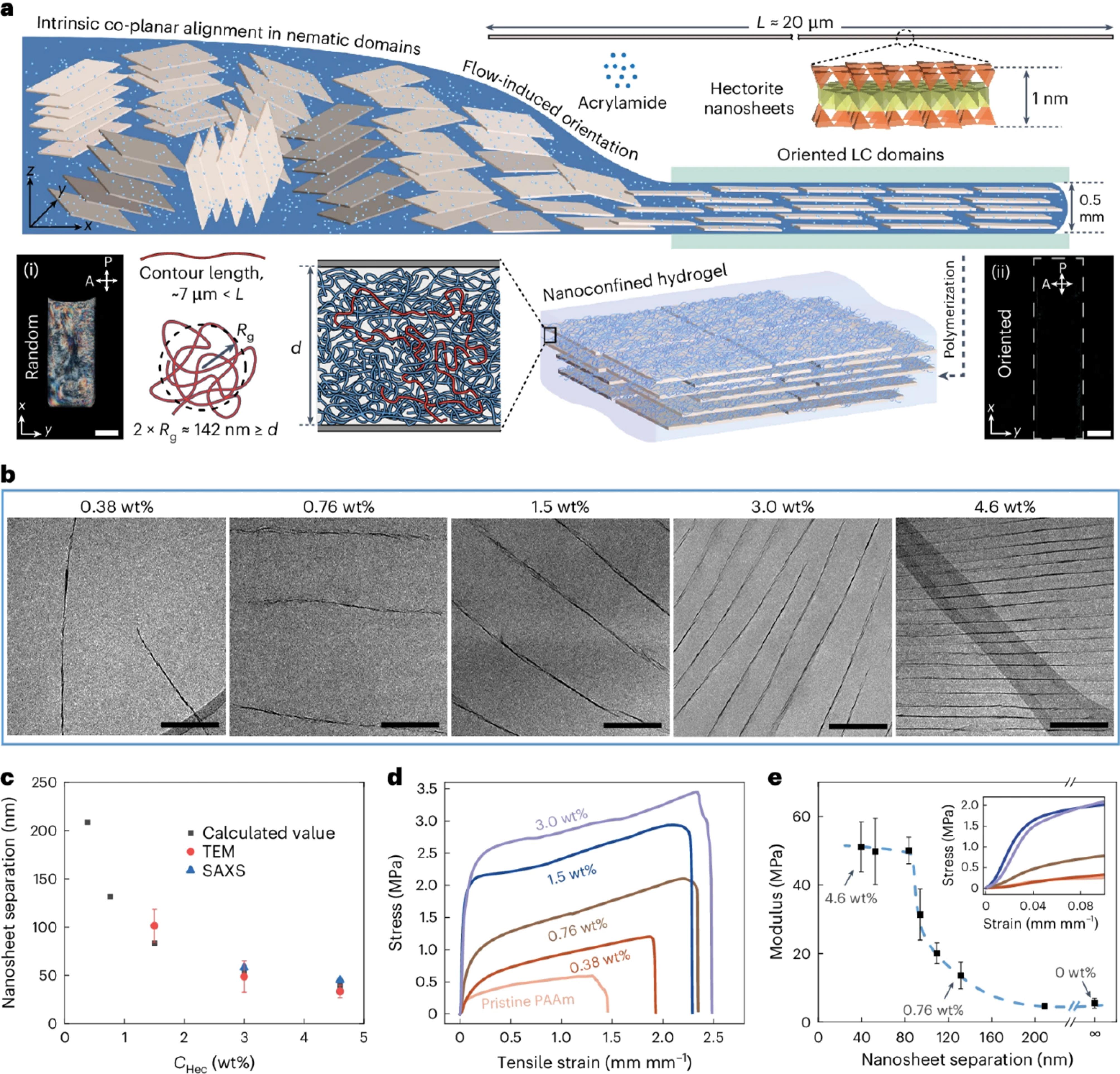
Fig. 1.
a. A schematic illustrates the orientation of nematic liquid crystal (LC) domains in nanosheets and an entangled hydrogel. High aspect ratio (AR) monolayer nanosheets enable co-planar alignment and macroscopic LC domain orientation under mild shear flow, with polarized images showing different hectorite dispersion thicknesses. b. TEM Analysis: TEM characterizes the aligned co-planar nanosheets within the nanoconfined hydrogel. c. Nanosheet Separation: Measurements of nanosheet separation using TEM and small-angle X-ray scattering (SAXS) are compared to calculated values based on hectorite concentrations. d, e. Mechanical Properties: Tensile stress-strain curves and elastic moduli are analyzed concerning nanosheet separation, indicating the effects of confinement, with data presented as mean values and standard deviations from multiple samples. Reproduced from Liang et al2 under a Creative Commons Attribution 4.0 International License (http://creativecommons.org/licenses/by/4.0/).
.
a. A schematic illustrates the orientation of nematic liquid crystal (LC) domains in nanosheets and an entangled hydrogel. High aspect ratio (AR) monolayer nanosheets enable co-planar alignment and macroscopic LC domain orientation under mild shear flow, with polarized images showing different hectorite dispersion thicknesses. b. TEM Analysis: TEM characterizes the aligned co-planar nanosheets within the nanoconfined hydrogel. c. Nanosheet Separation: Measurements of nanosheet separation using TEM and small-angle X-ray scattering (SAXS) are compared to calculated values based on hectorite concentrations. d, e. Mechanical Properties: Tensile stress-strain curves and elastic moduli are analyzed concerning nanosheet separation, indicating the effects of confinement, with data presented as mean values and standard deviations from multiple samples. Reproduced from Liang et al2 under a Creative Commons Attribution 4.0 International License (http://creativecommons.org/licenses/by/4.0/).
Moreover, another NCP strategy was studied to develop tough hydrogels, ionogels, and organogels that display damage-free reinforcement and increased crack propagation resistance under large deformations.4 This method develops strong hydrogen bonding interactions between covalent organic frameworks (COFs) or molecular sieves and interpenetrating polymer segments, successfully immobilizing the polymer chains to avoid slippage under load, which hinders hysteresis during cyclic loading and meaningfully decreases crack propagation sensitivity. This NCP approach signifies a general procedure for synthesizing stretchable, hysteresis-free gels with improved mechanical properties, making it a valuable contribution to the field of advanced materials. The researchers explored several chemical crosslinkers with varying chain lengths to tailor network density and mechanical behavior in the resulting hydrogels. All the obtained CR hydrogels confirmed remarkable improvements in strain, stress, and toughness compared to single-network hydrogels, displaying nearly ideal elasticity over large deformation ranges without obvious remaining strain or hysteresis after 100 loading–unloading cycles. The nanoconfined hydrogels exhibited outstanding elasticity and recovery during repeated deformation, maintaining structural integrity and minimizing energy loss compared to conventional networks. In another recent research, an innovative nanoconfined polymerization strategy was advanced to produce tough, near-zero-hysteresis gels capable of withstanding large deformations, addressing the limitations of traditional gel materials.4 The study demonstrated significant enhancements in mechanical durability, highlighting the potential of this approach for developing highly resilient soft materials for diverse applications. As is evident, this innovative NCP approach is not merely in reaching higher stiffness with healing, but in the mechanistic clarity of entangled chain reconnection within confinement.
Another ground breaking study established a dynamic nanoconfinement strategy as a powerful pathway for engineering super-tough, self-healing, and conductive polymers, advancing the field of durable soft electronics for demanding, deformable applications.11 They introduced a hydrogen-bonded nanoconfinement structure within polyurethane (TSPU), combining hierarchical hydrogen bonding, slight covalent crosslinking, and rigid nanoconfinement domains to achieve an unprecedented balance of ultrahigh strength, extreme stretchability, and self-healing ability. This design enables the formation of soft electrodes where a eutectic gallium–indium (EGaIn) liquid metal layer maintains stable conductivity. The resulting material demonstrates exceptional mechanical robustness, tensile strength and elongation up to 2500%, while retaining reliable electrical performance. Moreover, the recent study developed a nonswellable, conductive, and self-healing hydrogel platform that combines mechanical resilience, bioadhesion, and printability-offering a promising approach for next-generation implantable and wearable bioelectronics capable of long-term, stable tissue integration, and adaptable for bioelectronic interfaces.12 The material displays tissue-like softness, high stretchability, notable toughness, and rapid self-healing within 5 min. By incorporating carboxyl- and hydroxyl-functionalized carbon nanotubes (fCNTs), the developed hydrogel achieves high electrical conductivity that remains stable after mechanical deformation or rupture. Additionally, its tissue-adhesive nature and 3D-printable, shear-thinning behavior enable customizable, high-resolution fabrication for complex biological applications.
A major strength of this study lies in its conceptual shift from chemical modification to structural confinement as the key design parameter for achieving both stiffness and self-healing. By introducing co-planar nanoconfinement, the work successfully demonstrates that polymer chain dynamics can be locally maintained without sacrificing mechanical integrity, offering a new model for multifunctional soft materials. Moreover, its ability to integrate with functional fillers broadens the material’s potential for practical applications in robotics, biomedical devices, and sensing technologies. However, the study also presents some limitations that must be acknowledged. The reliance on precise nanosheet alignment and controlled shear processing may restrict large-scale or three-dimensional fabrication, limiting immediate industrial translation. Additionally, while the work demonstrates excellent mechanical and healing properties, systematic evaluation under physiological or long-term cyclic conditions is still needed to confirm performance stability in real-world environments. Overall, the work provides a compelling proof of concept that redefines design strategies in soft matter, yet continued efforts toward process optimization and broader validation will be essential to move from laboratory innovation to practical implementation.
Future directions
Looking ahead, numerous hopeful instructions warrant emphasis in the development of innovative hydrogels. As a few opportunities and considerations, this confinement method currently relies on monodomain alignment and careful nanosheet shearing. Translating to bulk constructs or 3D printing would demand approaches for preserving arrangement in thick sections, possibly via gradient templating or field-assisted assembly.13 Moreover, stimuli-responsive entanglement control offers a promising opportunity by incorporating stimuli-responsive linkers, such as pH-, thermo-, or light-sensitive materials, that can selectively modulate entanglement density, allowing on-demand switching of stiffness or triggering healing procedures.14 Furthermore, the development of hybrid networks that combine entanglements with dynamic bonds can create faster healing kinetics and improve multiscale damage recovery, addressing both macro cracks and micro voids effectively. The strong adhesion of these materials to substrates is promising; however, in biomedical or wearable applications, dynamic adhesion will be essential. This can be reinforced by adding adhesion-mediating ligands or applying interfacial control layers to improve flexibility. Besides, translating these innovations toward device combination could unlock multifunctional systems for applications in soft robotics, sensors, or implants by incorporating bioactive moieties, microchannels, or electrodes, within these stiff-healable hydrogels.15 In sum, the paper proposes a compelling method to materials design that uses geometry and confinement to balance the conflicting needs for flexibility and rigidity. It inspires a new generation of soft matter engineers to focus on mobility within constrained spaces instead of just relying on chemical stiffness. If these instructions are pursued, they could meaningfully advance the field towards soft materials that rival biological tissues in terms of both repairability and strength.
Conclusion
In conclusion, the recent NCP strategy effectively resolves a longstanding trade-off in hydrogel science by demonstrating the potential for rigidity and healing to coexist synergistically. By effectively applying co-planar nanoconfinement and polymer entanglements, this innovative approach provides a new design framework in which dynamic functionality and mechanical performance are seamlessly integrated. This editorial emphasizes that the key innovation lies in the architectural philosophy of facilitating local mobility within a globally confined structure. Such a design paradigm not only enhances the material's performance but also opens avenues for future advancements in various fields, including adaptive materials, soft robotics, and biomedicine, ultimately leading to the development of multifunctional systems that can respond effectively to changing conditions.
Study Highlights
-
Nanoconfinement enables hydrogels to achieve a remarkable balance of strength and self-healing capabilities, effectively addressing the conventional conflict between stiffness and flexibility.
-
Nanoconfined polymerization allows local chain mobility, resulting in robust, hysteresis-free gels that exhibit exceptional recovery under repeated stress.
-
This innovative approach introduces a new design concept for soft materials, supporting future applications in biomedicine, wearable sensors, and soft robotics.
Competing Interests
The authors declare that there are no conflicts of interest related to this publication process.
Data Availability Statement
Data will be made available on request.
Ethical Approval
The study procedure was approved by the Ethical Committee of the Tabriz University of Medical Science with the ethical approval code of IR.TBZMED.VCR.REC.1404.077.
References
- Datta D, Colaco V, Bandi SP, Dhas N, Janardhanam LS, Singh S. Stimuli-responsive self-healing ionic gels: a promising approach for dermal and tissue engineering applications. ACS Biomater Sci Eng 2025; 11:1338-72. doi: 10.1021/acsbiomaterials.4c02264 [Crossref] [ Google Scholar]
- Liang C, Dudko V, Khoruzhenko O, Hong X, Lv ZP, Tunn I. Stiff and self-healing hydrogels by polymer entanglements in co-planar nanoconfinement. Nat Mater 2025; 24:599-606. doi: 10.1038/s41563-025-02146-5 [Crossref] [ Google Scholar]
- Olfat Noubari Z, Golchin A, Fathi M, Nakhlband A. Designing robust chitosan-based hydrogels for stem cell nesting under oxidative stress. Bioimpacts 2022; 12:57-64. doi: 10.34172/bi.2021.23831 [Crossref] [ Google Scholar]
- Li W, Wang X, Liu Z, Zou X, Shen Z, Liu D. Nanoconfined polymerization limits crack propagation in hysteresis-free gels. Nat Mater 2024; 23:131-8. doi: 10.1038/s41563-023-01697-9 [Crossref] [ Google Scholar]
- Jones LO, Williams L, Boam T, Kalmet M, Oguike C, Hatton FL. Cryogels: recent applications in 3D-bioprinting, injectable cryogels, drug delivery, and wound healing. Beilstein J Org Chem 2021; 17:2553-69. doi: 10.3762/bjoc.17.171 [Crossref] [ Google Scholar]
- Mishra S, Singh I, Chauhan SB. Innovations in self-healing polymers for next-generation wearable electronics: materials, mechanisms, and future direction. Curr Mater Sci 2025; 18. doi: 10.2174/0126661454370527250624083558.
- Nagaraja K, Bhattacharyya A, Jung M, Kim D, Khatun MR, Noh I. 3D bioprintable self-healing hyaluronic acid hydrogel with cysteamine grafting for tissue engineering. Gels 2024; 10:780. doi: 10.3390/gels10120780 [Crossref] [ Google Scholar]
- Nezhad-Mokhtari P, Hamishehkar H, Farahpour MR, Mehdipour A, Rahbarghazi R, Milani M. Engineered bioadhesive self-healing nanocomposite hydrogel to fight infection and accelerate cutaneous wound healing. Chem Eng J 2024; 489:150992. doi: 10.1016/j.cej.2024.150992 [Crossref] [ Google Scholar]
- Xu Z, Chen Y, Cao Y, Xue B. Tough hydrogels with different toughening mechanisms and applications. Int J Mol Sci 2024; 25:2675. doi: 10.3390/ijms25052675 [Crossref] [ Google Scholar]
- Alvarez-Fernandez A, Maiz J. Advancements in polymer nanoconfinement: tailoring material properties for advanced technological applications. RSC Appl Polym 2024; 2:1013-25. doi: 10.1039/d4lp00234b [Crossref] [ Google Scholar]
- Wang JP, Fu C, Wu Z, Lan H, Cui S, Qi T. A dynamic nanoconfinement strategy towards self-healing soft electronics with super stretchability, ultrahigh strength and reliably high conductivity. J Mater Chem A 2022; 10:21093-101. doi: 10.1039/d2ta04932e [Crossref] [ Google Scholar]
- Park J, Kim JY, Heo JH, Kim Y, Kim SA, Park K. Intrinsically nonswellable multifunctional hydrogel with dynamic nanoconfinement networks for robust tissue-adaptable bioelectronics. Adv Sci (Weinh) 2023; 10:e2207237. doi: 10.1002/advs.202207237 [Crossref] [ Google Scholar]
- Roppolo I, Caprioli M, Pirri CF, Magdassi S. 3D printing of self-healing materials. Adv Mater 2024; 36:e2305537. doi: 10.1002/adma.202305537 [Crossref] [ Google Scholar]
- Protsak IS, Morozov YM. Fundamentals and advances in stimuli-responsive hydrogels and their applications: a review. Gels 2025; 11:30. doi: 10.3390/gels11010030 [Crossref] [ Google Scholar]
- Kim HJ, Koo JH, Lee S, Hyeon T, Kim D-H. Materials design and integration strategies for soft bioelectronics in digital healthcare. Nat Rev Mater 2025; 10:654-73. doi: 10.1038/s41578-025-00819-w [Crossref] [ Google Scholar]