Bioimpacts. 16:33423.
doi: 10.34172/bi.33423
Original Article
Development of a terbium-based coordination polymer nanoprobe for determination of clonazepam in exhaled breath condensate
Zahra Najafzadeh Investigation, Writing – original draft, 1 
Tahir Suleymanov Formal analysis, Validation, 2
Maryam Khoubnasabjafari Formal analysis, Visualization, 3, 4
Vahid Jouyban-Gharamaleki Data curation, Visualization, 5, 6
Jalal Hanaee Formal analysis, Validation, 7
Elaheh Rahimpour Conceptualization, Funding acquisition, Methodology, Project administration, Resources, Writing – review & editing, 8, *
Abolghasem Jouyban Conceptualization, Project administration, Supervision, Writing – review & editing, 8, 7
Author information:
1Infectious and Tropical Diseases Research Center, Tabriz University of Medical Sciences, Tabriz, Iran
2Department of Pharmaceutical Chemistry, Azerbaijan Medical University, Baku, Azerbaijan
3Department of Anesthesiology and Critical Care Medicine, Faculty of Medicine, Tabriz University of Medical Sciences, Tabriz, Iran
4Tuberculosis and Lung Diseases Research Center, Tabriz University of Medical Sciences, Tabriz, Iran
5Liver and Gastrointestinal Diseases Research Center, Tabriz University of Medical Sciences, Tabriz, Iran
6Kimia Idea Pardaz Azarbayjan (KIPA) Science Based Company, Tabriz University of Medical Sciences, Tabriz, Iran
7Faculty of Pharmacy, Tabriz University of Medical Sciences, Tabriz, Iran
8Pharmaceutical Analysis Research Center, Pharmaceutical Sciences Institute, Tabriz University of Medical Sciences, Tabriz, Iran
Abstract
Introduction:
Clonazepam is a long-acting benzodiazepine utilized for conditions such as seizures, panic disorder, and other neurological/psychiatric disorders. It functions by increasing GABA effects, which leads to reduced neural activity. Careful dosage titration and monitoring are necessary due to potential side effects, including drowsiness, impaired motor coordination, memory loss, and dependence.
Methods:
In this work, an optical probe based on a terbium (Tb) coordination polymer was developed for the quantification of clonazepam in the exhaled breath condensate (EBC). The principle of the probe was based on the interaction of clonazepam with pyridine-2,6-dicarboxylic acid -Tb coordination polymer nanoparticles, which dynamically quenches the Tb³⁺ luminescence through a collisional mechanism, as confirmed by the linear Stern-Volmer plot and the increased quenching efficiency at higher temperatures. As the increase in response intensity is proportional to clonazepam concentration, a method was offered for its determination in EBC samples.
Results:
This method presented a linear relationship with clonazepam concentration in the range of 0.001-1.5 µg.mL-1 with a limit of detection of 0.0002 µg.mL-1 and the intra-day and inter-day relative standard deviation of 1.8%, and 2.7%, respectively. The validated method was used for clonazepam analysis in patients receiving this medication. The recovery values, ranged from 90% to 104%, served as an indicator of the method's accuracy, and confirmed that the measured signal was attributable specifically to clonazepam with high reliability.
Conclusion:
By being faster, simpler, and cost-effective than traditional techniques, this method presented a valuable tool for therapeutic drug monitoring.
Graphical Abstract
Keywords: Clonazepam, Nanoprobe, Coordination polymer nanoparticles, Exhaled breath condensate
Copyright and License Information
© 2026 The Author(s).
This work is published by BioImpacts as an open access article distributed under the terms of the Creative Commons Attribution Non-Commercial License (
http://creativecommons.org/licenses/by-nc/4.0/). Non-commercial uses of the work are permitted, provided the original work is properly cited.
Funding Statement
This work was supported by Research Affairs of Tabriz University of Medical Sciences, under grant number 76261.
Introduction
Clonazepam is a long-acting benzodiazepine, anticonvulsant, and antianxiety drug widely used in neurological and psychiatric disorders such as seizures, panic disorder, mania, and REM sleep behavior disorder. The action mechanism of this drug is to increase serotonin synthesis and enhance GABA-A receptors; this drug increases the frequency of opening of chloride channels in neurons, leading to hyperpolarization and decreased neural activity, leading to anticonvulsant, sedative, and antianxiety effects.1 The dosage and administration of the drug depend on the type of disorder, with treatment starting at a low dose and gradually increasing. To avoid side effects, gradual dose increases and careful monitoring of treatment are essential. Clonazepam use causes side effects such as drowsiness, impaired motor coordination, confusion, memory loss, and dependence. Regular monitoring is necessary to reduce the risk of cognitive and motor impairment, depression, and potential abuse.2
Different analytical methods have been reported to measure clonazepam level in various biological samples, including reverse phase high performance liquid chromatography (RP-HPLC)-UV,3 liquid chromatography tandem mass spectrometry (LC-MS/MS),4 gas chromatography-mass spectrometry (GC-MS),5 electrochemical sensor,6,7 colorimetric sensor,8 and spectrofluorometric methods.9,10 Despite its high accuracy and separation power, the chromatographic method requires complex, time-consuming and expensive sample preparation steps. Electrochemical sensors have been proposed as a rapid and sensitive. However, these methods suffer from insufficient selectivity. This creates a demand for affordable and user-friendly platforms to detect clonazepam in biological samples.
In recent decades, nanomaterials have provided sensitive, selective, and rapid platforms for drug detection. Coordination polymers (CPs), as a class of nanomaterials, are hybrid materials composed of metal ions and organic ligands that are used in chemical and biological sensing, catalysis, drug delivery, and imaging due to their high stability and unique optical properties. Their optimized design allows the fabrication of highly sensitive, selective, and fast-response fluorescence sensors for the visual and real-time detection of analytes.11 Terbium (Tb) stands out among the lanthanides for luminescence-based sensing due to a unique combination of advantageous photophysical properties. These include a long-lived emission with an exceptionally narrow and intense spectral band, high photochemical stability, and the ability to tune its excitation wavelength through strategic ligand selection.12 Furthermore, its significant charge and ionic radius allow for direct coordination with analytes. Furthermore, Tb emission parameters are highly responsive and susceptible to changes in the local chemical environment upon interaction with target molecules,13 making it an ideal center for constructing responsive sensing platforms. Herein, the ligand pyridine-2,6-dicarboxylic acid (PDCA) was chosen to synthesize Tb-based CPs (Tb-CPs). PDCA acted as an effective tridentate chelator, facilitating the formation of a stable and well-defined polymeric network. To the best of our knowledge, this work represented the first application of a CP-based fluorescent probe for the detection and determination of clonazepam. A particularly innovative aspect of this study was its focus on analyzing exhaled breath condensate (EBC). It acted as a promising and non-invasive alternative biological sample14 minimized patient discomfort and clinical complexity. This approach therefore, targeted a critical need for convenient monitoring in critical care settings.
Materials and Methods
Reagents and solutions
All consumables were of the analytical grade and deionized water was obtained from Shahid Ghazi Pharmaceutical Company (Tabriz, Iran). In this study, Tb (III) chloride hexahydrate (TbCl3·6H2O, Acros Organics, USA), PDCA (Merck, Germany) and Tris-HCl (Merck, Germany) were used. The standard stock solution of clonazepam (Sobhan Pharmaceutical Company, Iran) was prepared by dissolving a certain amount of the drug in ethanol, and working solutions were prepared daily by diluting the stock solution in ultrapure water.
Apparatus and instruments
Fluorescence spectra were recorded with a FP-750 spectrofluorometer (Jasco, Japan) with a bandwidth of 5 nm in the excitation and emission directions. Data control and processing were performed with the Windows-based Spectra Manager TM software. The shape, size, and elemental composition of the nanoparticles were examined by scanning electron microscopy (SEM) and energy dispersive X-ray spectroscopy (EDX) MIRA III model (TESCAN, Czech Republic), and the hydrodynamic size and size distribution of the particles in solution were determined by a dynamic light scattering (DLS) instrument (Philips, Leiden, The Netherlands). The pH of the solutions was adjusted with a digital pH meter model 744 (Metrohm Ltd., Switzerland) and the materials were weighed with an electronic analytical balance model AB204-S (Mettler Toledo, Switzerland).
Synthesis of Tb-PDCA CP nanoparticle (NPs)
For synthesis of Tb-PDCA CP NPs, 200 μL of 75 mmol·L-1 PDCA solution and 100 μL of 5.36 mmol·L-1 Tb solution were added to 5 mL of 48 mmol·L-1 Tris–HCl buffer (pH 7.4) and the resulting mixture was stirred for 30 min at room temperature using a magnet on a magnetic stirrer to perform the coordination reaction and form CP NPs.15
Sample preparation
EBC samples were collected using a laboratory-made device and used directly for analysis without the need for prior preparation.16 The samples used in the optimization and calibration phase were collected from healthy volunteers, while for the real-world sample study, patients under mechanical ventilation were selected as subjects and tracheal aspirates were collected from the ventilator waste. All participants provided written informed consent under a protocol approved by the Tabriz University of Medical Sciences as IR.TBZMED.REC.1404.299.
General procedure
At this stage, 150 μL of EBC sample (either real or clonazepam spiked) was poured into a microtube and then 10 μL of citrate buffer (0.1 mol.L-1) with a pH of 5.0 was added. After that, 45 μL of the synthesized Tb-PDCA CP NPs were added to the solution and the total volume was adjusted to 400 μL with ultrapure water. Fluorescence intensity was measured at λem = 546 nm (λex = 374 nm). The analytical signal, ΔF, was defined as F0 – F, where F and F0 are the fluorescence intensities with and without clonazepam, respectively. All measurements were performed in triplicate at room temperature, and the mean value was reported.
Results and Discussion
Characterization of PDCA -Tb CP
The morphology of the Tb-PDCA CP NPs was characterized by SEM analysis. Fig. 1A presents the SEM images of the probe before and after the addition of thiopental. DLS analysis, shown in Fig. 1B, indicated a primary particle size distribution of less than 100 nm. Successful synthesis was also verified using EDX spectroscopy and spectrofluorimetry. The EDX spectrum (Fig. 1C) confirmed the expected chemical composition, including the elements C, N, O, and Tb. Further confirmation was provided by the fluorescence spectrum (Fig. 1D), which, under 374 nm excitation, displayed three characteristic emission peaks at 492, 546, and 587 nm, consistent with the formation of the probe.
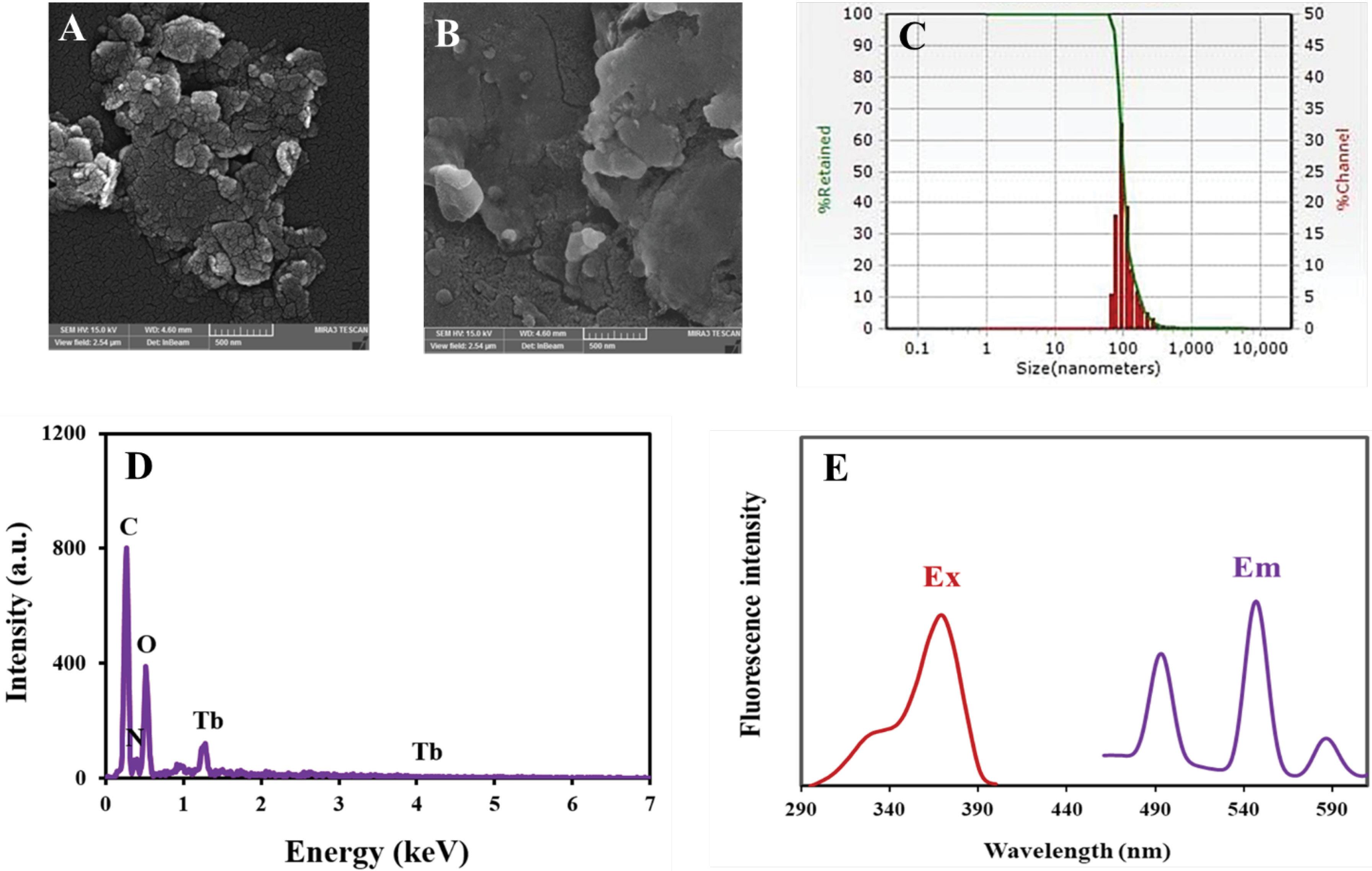
Fig. 1.
Characterization findings: (A) SEM image of Tb-PDCA CP NPs before (left) and after clonazepam addition (right); (B) DLS analysis, (C) EDX analysis and (D) excitation/emission spectrum of synthesized Tb-PDCA CP NPs.
.
Characterization findings: (A) SEM image of Tb-PDCA CP NPs before (left) and after clonazepam addition (right); (B) DLS analysis, (C) EDX analysis and (D) excitation/emission spectrum of synthesized Tb-PDCA CP NPs.
Mechanism of clonazepam sensing
In this system, the detection element was a Tb-based CP. This material was architecturally defined by Tb³⁺ ions acting as central metallic nodes, which were structurally connected into an expansive, ordered network through bridging organic ligands of PDCA. When photoexcited at a wavelength of 374 nm, the Tb-PDCA CP displayed the signature green luminescence of Tb ions, with distinct emission peaks at 492, 546, and 587 nm (Fig. 2). The intense luminescence was primarily driven by an "antenna effect," whereby the PDCA ligands effectively absorbed incident light and subsequently transferred the energy to the Tb³⁺ ions, sensitizing their characteristic emission.
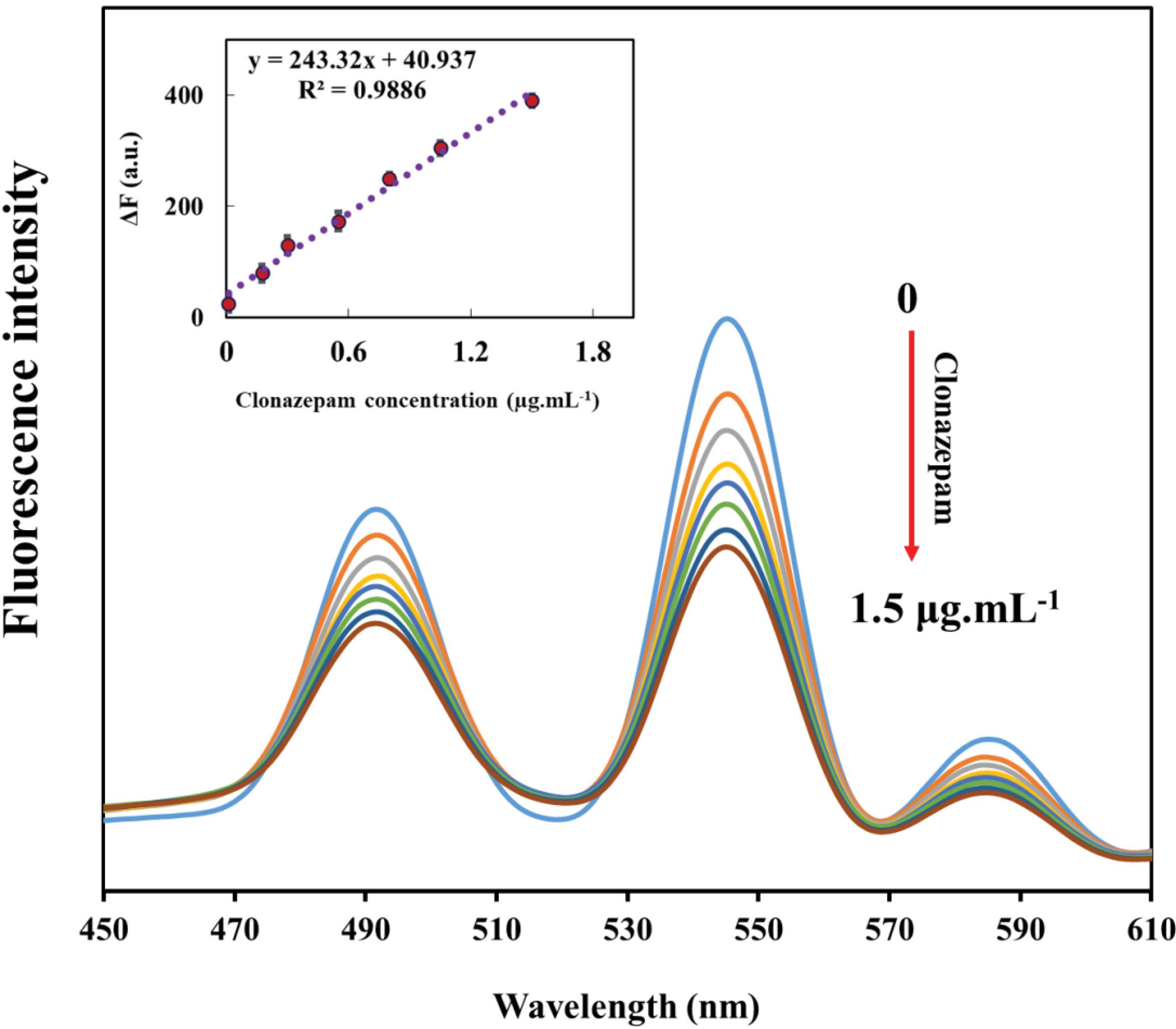
Fig. 2.
The fluorescence spectra of PDCA-Tb CP-based probe in the absence and presence of clonazepam at different concentrations (0.001-1.5 µg.mL-1).
.
The fluorescence spectra of PDCA-Tb CP-based probe in the absence and presence of clonazepam at different concentrations (0.001-1.5 µg.mL-1).
The analytical capability of the resulting Tb-PDCA CP probe was evaluated using the benzodiazepine drug clonazepam as a model analyte. Upon introducing clonazepam to an aqueous suspension of the Tb-PDCA CP probe, a pronounced and concentration-dependent quenching of the characteristic Tb luminescence was observed (Fig. 2). The photoluminescence intensity decreased as the concentration of clonazepam increased. This direct, proportional "turn-off" response established the system as a highly sensitive and quantitatively reliable fluorescent platform for the specific detection of clonazepam.
To elucidate the molecular mechanism underlying the fluorescence quenching, a Stern-Volmer analysis was performed. This analytical approach quantified the interaction between a luminescent probe and a quencher by measuring the reduction in emission intensity as a function of increasing quencher concentration. The data were processed according to the classical Stern-Volmer equation,
Where F0 and F represent the steady-state luminescence intensities in the absence and presence of the quencher (clonazepam), [Q] is the quencher concentration, and KSV is the Stern-Volmer quenching constant, which quantitatively reflects the quenching efficiency. So, the characteristics of the Stern-Volmer plot and the temperature-dependent behavior of KSV serve to distinguish between the two quenching modalities: static quenching, which involves the pre-association of the fluorophore and quencher into a non-emissive ground-state complex, and dynamic (collisional) quenching, which occurs through diffusive encounters that deactivate the fluorophore's excited state.
In this work, the quenching of the Tb-PDCA CP NPs emission by clonazepam was conclusively identified as a dynamic process. This assignment was based on two experimental findings. First, the Stern-Volmer plot (F0/F versus [Q]) yielded a linear correlation across the studied concentration range (Fig. 3), consistent with a single, homogeneous quenching process. Second, and most diagnostically, the calculated KSV values exhibited a positive temperature dependence, increasing with rising temperature from 15 up to 35 ⁰C. This behavior was a symbol of dynamic quenching, as elevated thermal energy accelerated molecular diffusion, thereby increasing the frequency of collisional encounters between the quencher and the luminescent centers. It should be noted that the spectrofluorometer’s cell holder was equipped with a thermostat that provided temperature control ranging from 0 to 40 °C.
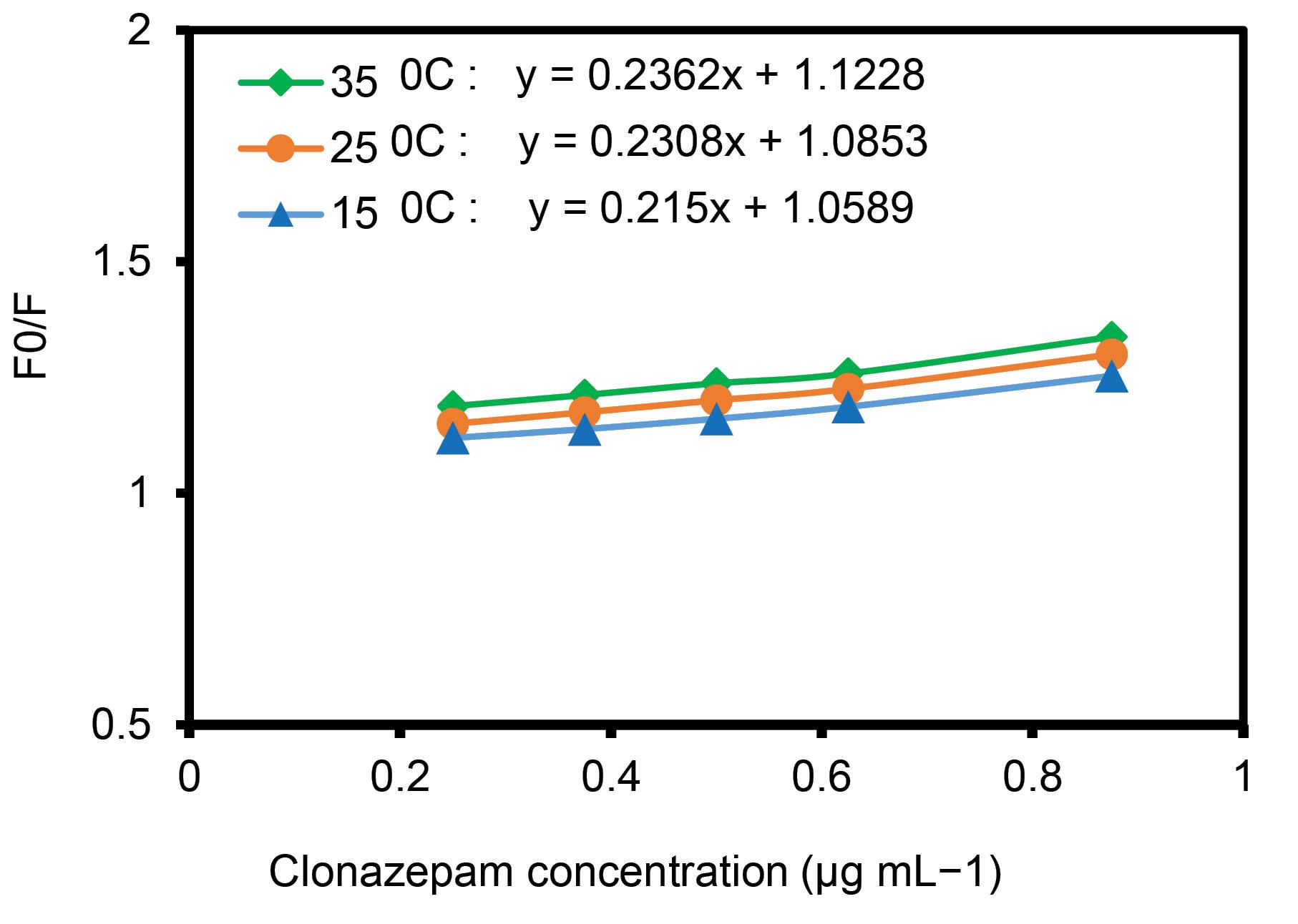
Fig. 3.
Stern–Volmer plot for the quenching of Tb-PDCA CP NPs based probe by clonazepam.
.
Stern–Volmer plot for the quenching of Tb-PDCA CP NPs based probe by clonazepam.
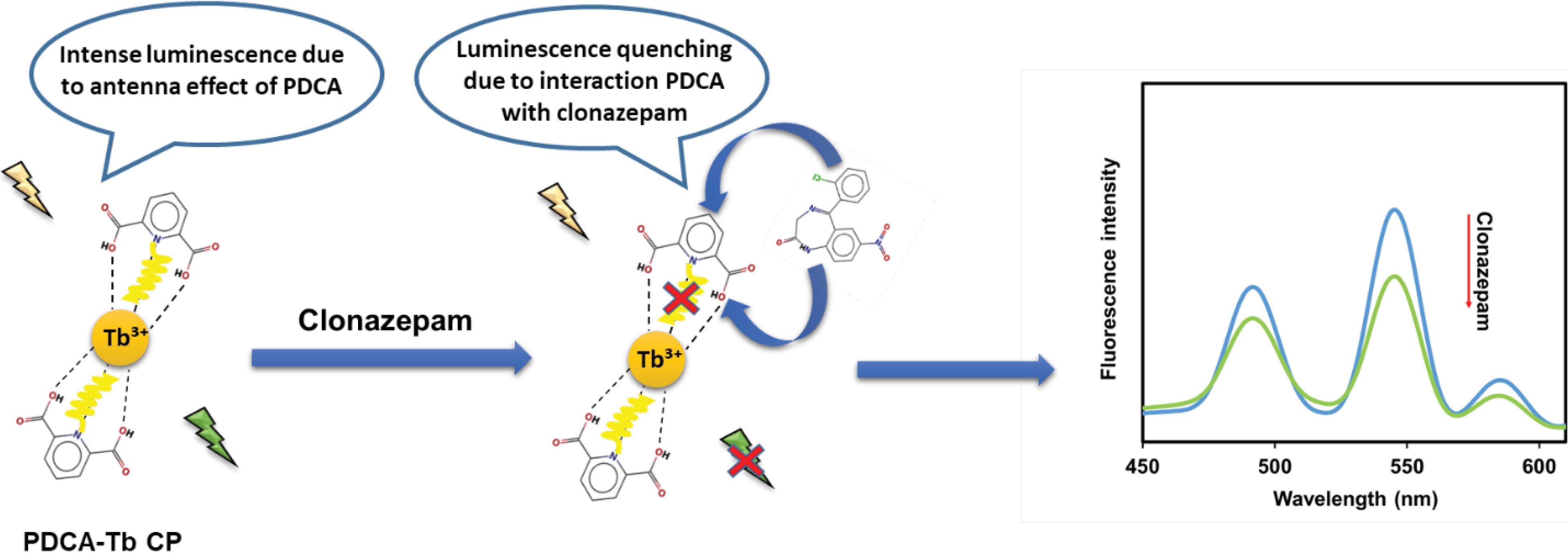
The structural features of clonazepam directly enabled this efficient collisional quenching mechanism. The aromatic and electron-deficient nature of clonazepam may allow for weak non-covalent interactions (e.g., π-π stacking or electrostatic interactions) with the aromatic rings of the PDCA ligands or the nanoparticle surface. This proximity could facilitate photoinduced electron transfer from the excited state of the probe to clonazepam, providing a non-radiative decay pathway, enhancing the quenching efficiency and leading to the observed concentration-dependent attenuation, or "turn-off," of the characteristic green luminescence (Scheme 1).
Scheme 1.
Schematic illustration of the quenching of Tb-PDCA CP NPs-based probe by clonazepam.
.
Schematic illustration of the quenching of Tb-PDCA CP NPs-based probe by clonazepam.
Optimization of reaction conditions
Preliminary experiments showed three variables with a significant effect on the probe's fluorescence response: the pH of the solution, the amount of Tb-PDCA CP NPs used, and the incubation time for the interaction. To provide a consistent basis for this optimization, a standardized clonazepam concentration of 0.3 µg.mL-1 was chosen as the analyte concentration. The first parameter was the solution's pH and measurements of the fluorescence response were taken across a pH spectrum from 3.0 to 9.0. The results revealed a pH-dependent pattern; as the pH increased up to 5.0, the intensity of the fluorescence signal (ΔF) increased and when the pH was raised above this optimal point, a gradual decrease in the fluorescence signal was noted, as depicted in Fig. 4A. This drop is likely due to changes in the protonation state of the probe leading to the deactivation of the Tb-PDCA system under basic conditions. Thus, a pH of 5.0 was chosen as the optimal condition. Next, the amount of Tb-PDCA CP NPs was investigated in a range from 10 to 60 µL. The result, presented graphically in Fig. 4B, demonstrated that the fluorescence response increased with greater volumes of Tb-PDCA CP up to 45 µL and reached a plateau at higher amounts. This means all binding or sensitizing sites were occupied, so adding more nanoparticles no longer increased the fluorescence signal. So, the optimum response was achieved at a volume of 45 µL. Following this, a final analysis was performed to determine the impact of incubation time on the analytical response. The nanoprobe's response toward clonazepam was tracked over a series of time intervals, from immediate measurement to periods longer than 20 minutes. The findings (Fig. 4C) presented that the nanoprobe's signal maintained notable stability for up to 20 minutes, exhibiting no considerable loss in the intensity or change in the spectral properties. This suggested that the system achieved equilibrium almost immediately after mixing, eliminating any requirement for more incubation period to achieve the signal.
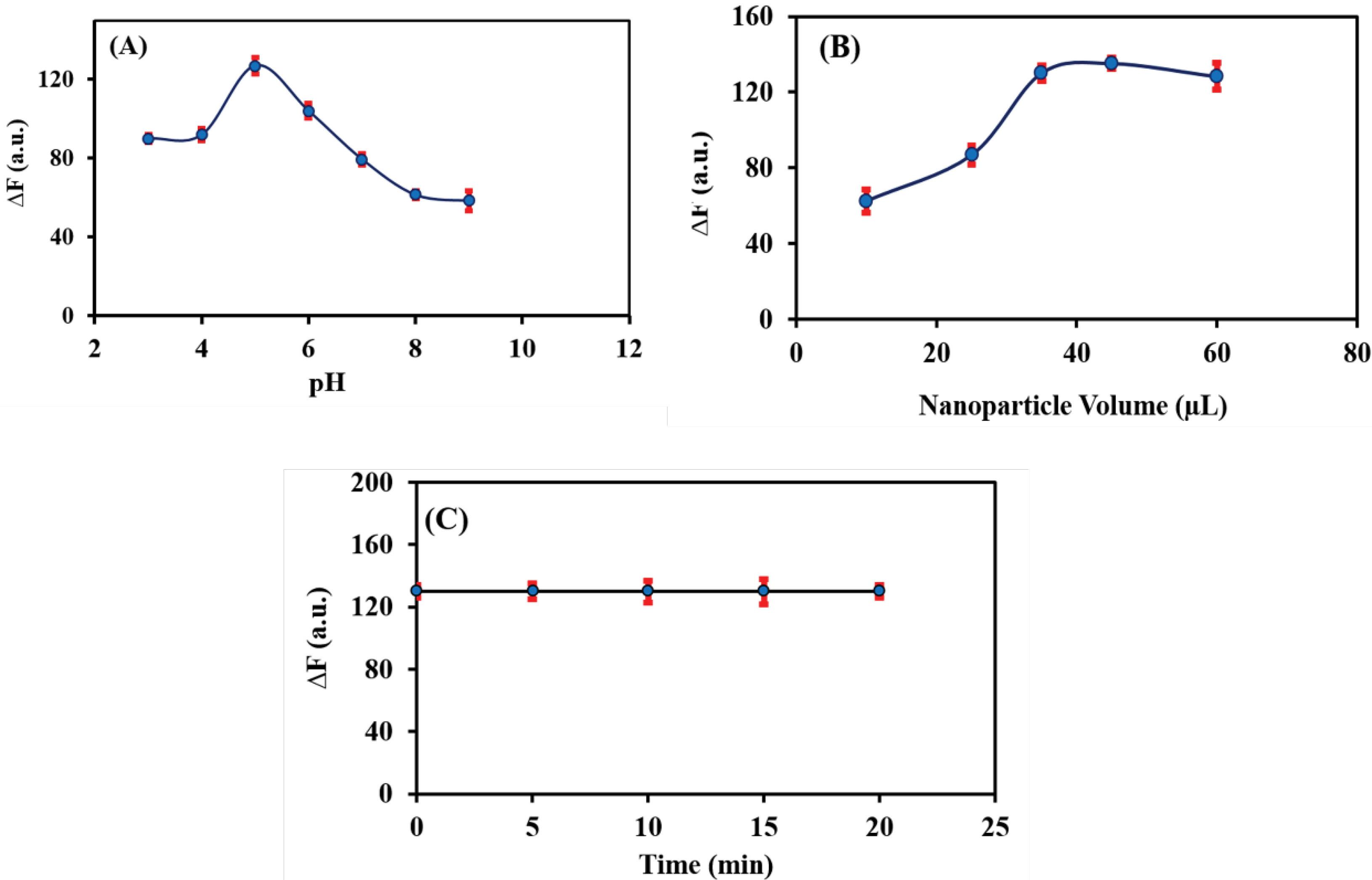
Fig. 4.
Impact of (A) pH, (B) the volume of PDCA-Tb CP NPs, and (C) time on the probe response.
.
Impact of (A) pH, (B) the volume of PDCA-Tb CP NPs, and (C) time on the probe response.
Analytical performance of the developed method
To study the analytical performance of the optimized nanoprobe for quantifying clonazepam, its concentration-dependent fluorescence behavior was analyzed in EBC samples. This investigation was performed using the previously determined optimal parameters to guarantee that the performance valuation accurately represented the probe's efficacy in a relevant application setting. Known concentrations of clonazepam were introduced into a series of EBC samples, and the corresponding changes in the system’s fluorescence intensity (ΔF) were recorded. The nanoprobe produced a correlated and linear analytical response to clonazepam across a concentration range of 0.001-1.5 µg.mL-1. This linear relationship was visually displayed in the inset of Fig. 2. Linear regression analysis produced the equation ΔF = 243.32 CClonazepam + 40.937. In this context, ΔF was defined as (F0 – F), where F0 represents the initial fluorescence intensity at 546 nm without clonazepam, and F was the intensity recorded after the analyte adding. The strength and reliability of this linear correlation were confirmed by a high coefficient of determination (R2 = 0.9886). The method's sensitivity was further characterized by calculating the limit of detection (LOD) using the formula 3Sb/m, where Sb was the standard deviation of multiple blank measurements and m was the slope of the calibration curve. The LOD was determined to be 0.0002 µg·mL-1. Additionally, the precision of the analytical method was evaluated through a replicate study. For five replicate analyses of an EBC sample containing 0.3 µg·mL-1 of clonazepam, the relative standard deviation (RSD) was 1.8%. The inter-day precision for the same concentration was calculated to be 2.7%.
Table 1 provided a comparative analysis of the performance features of the validated method against other reported techniques for clonazepam determination in various matrices. While sophisticated chromatographic methods like HPLC and GC are robust and trusted for laboratory use, they typically demand extensive sample preparation, advanced instrumentation, and specialized personnel. Electrochemical methods, on the other hand, often face limitations in selectivity against interferences and long-term reproducibility, potentially compromising reliability in complex samples. Optical methods offer a notable alternative, characterized by their portability, capacity for miniaturization, and suitability for rapid, on-site analysis which are key attributes for point-of-care diagnostics. The data in Table 1 indicated that our method achieved a linearity range and LOD comparable to, and in some instances better than, previously reported methods for this drug. This superior performance, particularly at lower concentrations, underscored the method’s high efficiency.
Table 1.
Comparison of the performance features of the validated method for clonazepam determination with other reported techniques
|
Method
|
Probe
|
Sample
|
LOD
(µg.mL-1) |
Linear range
(µg.mL-1) |
Reference
|
| RP-HPLC-UV |
- |
Aqueous samples |
- |
0.1-30 |
3
|
| LC-MS/MS |
- |
Urine |
|
0.002-0.3 |
4
|
| GC-MS |
- |
Pericardial fluid |
0.02 |
0.04-0.25 |
5
|
| Electrochemical sensor |
Multi-wall carbon nanotube molecularly imprinted polymer |
Drinking water,
urine, blood, tablet |
0.27 |
0.52-22.8 |
6
|
| Electrochemical sensor |
FeCu-LDH@MXene nanocomposite |
Pharmaceutical ampoules,
plasma |
0.03 |
0.2-134 |
7
|
| Colorimetric sensor |
DH-1,6-NAPY-8-CN-AgNPs |
Plasma |
0.0009 |
0.015-24.0 |
8
|
| Spectrofluorimetry |
Polydopamine nanoparticles |
Plasma |
- |
0.05-1.0
1.0-15.0 |
9
|
| Spectrofluorimetry |
Nitrogen-doped carbon dots |
Aqueous samples |
3.8 × 10⁻⁶ |
1.5 × 10⁻⁵ -0.002 |
10
|
| Spectrofluorimetry |
Tb-PDCA NPs |
EBC |
0.0002 |
0.001-1.5 |
This work |
Interference study
In order to investigate the selectivity of the probe towards clonazepam, the effect of other drugs, either over-the-counter, taken concurrently or structurally related, such as pantoprazole, aspirin, ibuprofen, losartan, chlordiazepoxide, alprazolam, amoxicillin, acetaminophen, propranolol, diltiazem, naproxen, oxazepam, and diazepam, was studied in a solution with a constant concentration of 0.3 µg.mL-1 and under optimal conditions. The data illustrated in Fig. 5 demonstrated that the probe's response remained mostly unaffected by the presence of the tested pharmaceuticals, except in the cases of oxazepam and diazepam. These results verified an acceptable level of specificity for the precise quantification of clonazepam. The observed interference from oxazepam and diazepam was likely due to their structural similarity to clonazepam, which compromised the accuracy of the clonazepam determination. To address these constraints, separation or extraction techniques could be employed prior to analysis. The exploration of such a strategy represented a potential avenue for future research aimed at enhancing the probe's specificity.
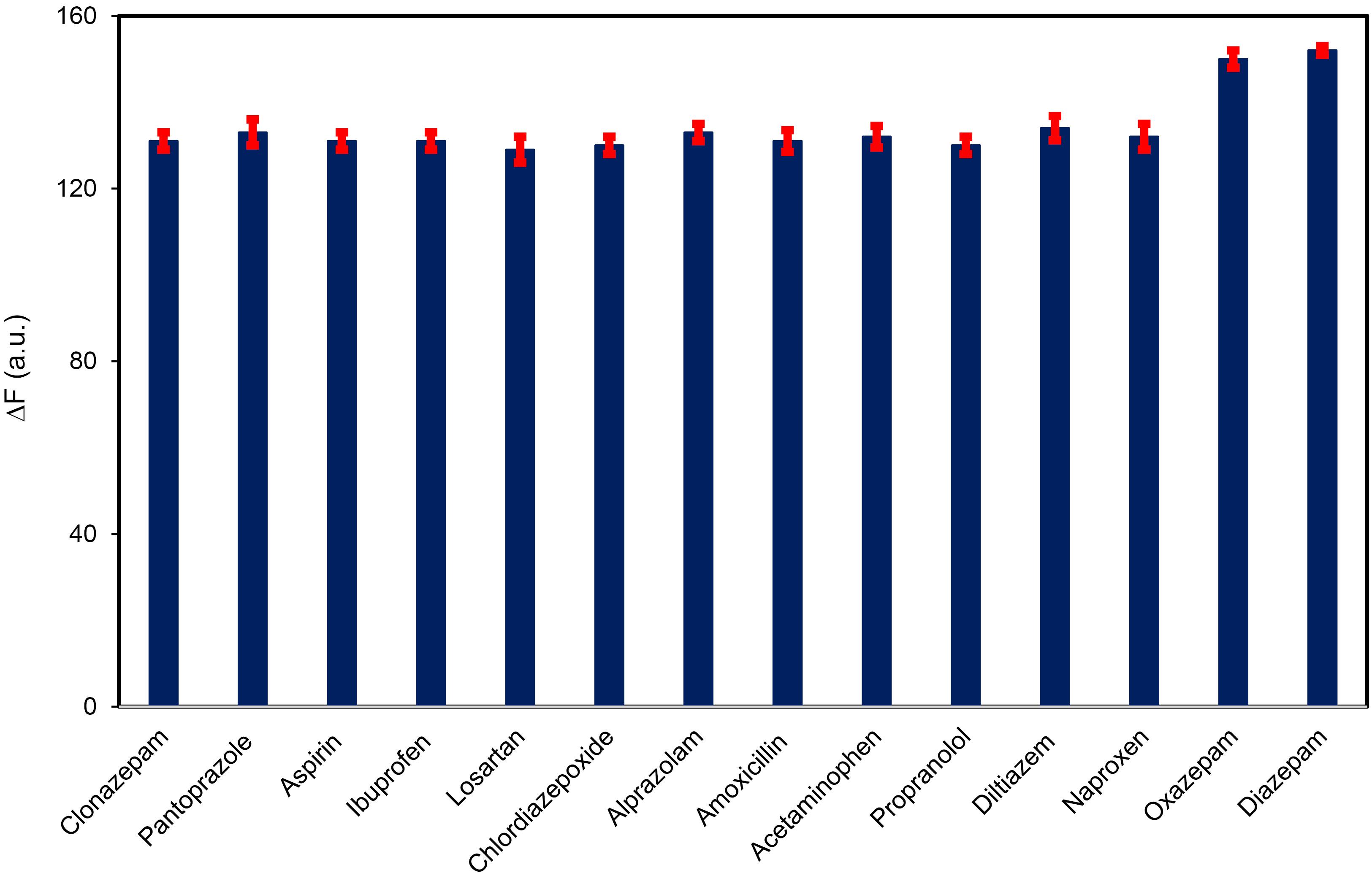
Fig. 5.
The selectivity study in the presence of interferences with a concentration of 0.3 μg.mL-1 (clonazepam concentration = 0.3 µg.mL-1).
.
The selectivity study in the presence of interferences with a concentration of 0.3 μg.mL-1 (clonazepam concentration = 0.3 µg.mL-1).
Determination of clonazepam in real EBC samples
The Tb-PDCA CP NPs-based fluorescent probe was applied to real-world analysis by determining clonazepam concentrations in the EBC of three medicated patients collected from the ventilator waste (results in Table 2). The reliability of these values and the potential for matrix interference were checked using a standard addition method, wherein samples were spiked with known quantities of clonazepam at two concentration levels (0.01 and 0.1 µg.mL-1). As shown in Table 2, the calculated recovery percentages fell within the acceptable range of 90% to 104%, confirming accuracy of the probe's response toward clonazepam in this biological matrix.
Table 2.
Determination of clonazepam concentration in EBC of medicated patients and recovery experiments
|
Sample
|
Added
(µg.mL–1) |
Found
(µg.mL–1) |
Recovery
(%)
a
|
| 1 |
- |
0.005 |
- |
| 0.01 |
0.014 |
90.0 |
| 0.1 |
0.1134 |
99.4 |
| 2 |
- |
0.007 |
- |
| 0.01 |
0.0174 |
104.0 |
| 0.1 |
0.118 |
100.6 |
| 3 |
- |
0.003 |
- |
| 0.01 |
0.0129 |
99.0 |
| 0.1 |
0.11 |
97.1 |
a Recovery (%) = [clonazepam concentration in samples (after spiking - before spiking)/Added] × 100.
Conclusion
This study developed a Tb-PDCA CP NPs-based fluorescence sensor for detecting clonazepam in EBC. The probe's fluorescence intensity decreased proportionally with rising clonazepam concentrations. A linear response was established over the range of 0.001 to 1.5 μg·mL-1, with a LOD of 0.0002 μg·mL-1. The method proved reliable, showing low variability (intra-day RSD: 1.8%; inter-day RSD: 2.7%). Compared to traditional chromatographic methods, this approach was quicker, simpler, and more economical, making it a promising tool for therapeutic drug monitoring to avoid toxicity or under-dosing. Future efforts should involve validation with larger patient groups to ensure consistency across different physiological states. This work highlighted the potential of nanomaterial probes and advanced EBC as a practical medium for non-invasive diagnostics.
Research Highlights
What is the current knowledge?
-
Clonazepam is a well-established long-acting benzodiazepine used to treat various neurological and psychiatric conditions.
-
Therapeutic drug monitoring of clonazepam is important due to potential side effects and the risk of dependence, necessitating careful dosage adjustments.
What is new here?
-
A simple fluorometric probe utilizing a terbium coordination polymer has been developed for quantifying clonazepam.
-
This method allows for the detection and measurement of clonazepam in EBC sample in the concentration range of 0.001-1.5 µg.mL-1
-
The developed probe offers a faster, simpler, and cost-effective approach to therapeutic drug monitoring of clonazepam compared to existing traditional techniques.
Competing Interests
The authors declare that they have no competing interests.
Data Availability Statement
All data generated or analyzed during this study are included in this published article.
Declaration of AI-assisted Tools in the Writing Procedure
The author(s) declare that Generative AI was not used in the creation of any figures included in this manuscript. During the preparation of this work the authors used DeepSeek AI Tool in order to improve the writing process and to enhance the readability and language of the manuscript. After using this tool/service, the authors reviewed and edited the content as needed and takes full responsibility for the content of the published article.
Ethical Approval
Ethical approval for this study was guided by the Declaration of Helsinki. Prior to participation, the study's objectives and procedures were explained to all individuals, with guarantees provided regarding the confidentiality and anonymity of their information. Written informed consent was obtained following this explanation. In the case of illiterate participants, interviewers read the consent form aloud in full prior to obtaining their consent. All participants were advised of their right to withdraw at any stage of the research. All participants provided written informed consent under a protocol approved by the Tabriz University of Medical Sciences as IR.TBZMED.REC.1404.299.
Acknowledgements
We would like to appreciate of the cooperation of Clinical Research Development Unit, Imam Reza General Hospital, Tabriz, Iran in conducting this research.
References
- Pinder RM, Brogden RN, Speight TM, Avery GS. Clonazepam: a review of its pharmacological properties and therapeutic efficacy in epilepsy. Drugs 1976; 12:321-61. doi: 10.2165/00003495-197612050-00001 [Crossref] [ Google Scholar]
-
Genis-Najera L, Sañudo-Maury ME. Bioequivalence study of two tablet formulations of clonazepam 2 mg: a randomized, open-label, crossover study in healthy Mexican volunteers under fasting conditions. Neurol Ther 2024. 13: 141-52. doi: 10.1007/s40120-023-00567-5.
- Kumar P, Chaudhary M, Rathi V, Singh B, Vyas M, Saini G. Validated analytical method development for drug residue (clonazepam) in pharmaceutical industries by RP-HPLC. AIP Conf Proc 2023; 2800:020139. doi: 10.1063/5.0162987 [Crossref] [ Google Scholar]
- Kamal H, Gandhi V, Akil L, Al-Tannak NF, Rattray NJW, Khadra I. Development and validation of an LC-MS/MS method for the simultaneous determination of alprazolam, bromazepam, clonazepam, diazepam and flunitrazepam in human urine and its application to samples from suspected drug abusers. Molecules 2025; 30:3451. doi: 10.3390/molecules30173451 [Crossref] [ Google Scholar]
- Álvarez-Freire I, Brunetti P, Cabarcos-Fernández P, Fernández-Liste A, Tabernero-Duque MJ, Bermejo-Barrera AM. Determination of benzodiazepines in pericardial fluid by gas chromatography-mass spectrometry. J Pharm Biomed Anal 2018; 159:45-52. doi: 10.1016/j.jpba.2018.06.039 [Crossref] [ Google Scholar]
- Keshtkar N, Rajabi HR, Roushani M, Abedi F. Fabrication of an electrochemical sensor based on molecularly imprinted polymer for the selective determination of clonazepam in various samples: study of the modifier effect. Anal Bioanal Chem Res 2024; 11:405-14. doi: 10.22036/abcr.2024.444478.2056 [Crossref] [ Google Scholar]
- Shahparast S, Asadpour-Zeynali K. Development of a novel and highly sensitive electrochemical sensor based on FeCu-LDH@MXene nanocomposite for the selective determination of clonazepam. Microchem J 2025; 211:113095. doi: 10.1016/j.microc.2025.113095 [Crossref] [ Google Scholar]
- Ali S, Umar AR, Hussain K, Muhammad H, Hanif M, Laiche MH. Ultra-trace level colorimetric composite sensor based on novel DH-1,6-NAPY-8-CN-AgNPs for the detection of clonazepam in aqueous and human plasma samples. J Ind Eng Chem 2023; 125:136-43. doi: 10.1016/j.jiec.2023.05.022 [Crossref] [ Google Scholar]
- Abbasi M, Jouyban A, Ranjbar F, Soleymani J. A versatile ratiometric fluorescence nanoprobe for the determination of clonazepam in patients' plasma samples. J Mol Recognit 2024; 37:e3088. doi: 10.1002/jmr.3088 [Crossref] [ Google Scholar]
- Ghafarloo A, Emamali Sabzi R, Samadi N, Hamishehkar H. Sensitive and selective spectrofluorimetric determination of clonazepam using nitrogen-doped carbon dots. J Photochem Photobiol A Chem 2020; 388:112197. doi: 10.1016/j.jphotochem.2019.112197 [Crossref] [ Google Scholar]
- Zaworotko MJ. Design and construction of coordination polymers. J Am Chem Soc 2010; 132:7821. doi: 10.1021/ja103305p [Crossref] [ Google Scholar]
- Yan B, Qiao XF. Photophysical properties of terbium molecular-based hybrids assembled with novel ureasil linkages. Photochem Photobiol 2007; 83:971-8. doi: 10.1111/j.1097.2007.00112 [Crossref] [ Google Scholar]
-
Rizk MA, Alsaiari MA, Alsaiari RA, Ibrahim IA, Abbas AM, Khairy GM. New terbium complex as a luminescent sensor for the highly selective detection of malathion in water samples. Chemosensors 2023. 11: 570. doi: 10.3390/chemosensors11120570.
- Khoubnasabjafari M, Rahimpour E, Jouyban A. Exhaled breath condensate as an alternative sample for drug monitoring. Bioanalysis 2018; 10:61-4. doi: 10.4155/bio-2017-0205 [Crossref] [ Google Scholar]
- Zhao X, Wu J, Tian W. Terbium (III)-based coordination polymer with millimeter-size single crystals and high selectivity and sensitivity for folic acid. CrystEngComm 2023; 25:945-52. doi: 10.1039/d2ce01608g [Crossref] [ Google Scholar]
- Sepehr B, Bavili-Tabrizi A, Jouyban-Gharamaleki V, Khoubnasabjafari M, Jouyban A. A sensitive determination of ammonia and nitrite in exhaled breath condensate of healthy humans by using Berthelot reaction. Curr Pharm Anal 2018; 14:555-61. doi: 10.2174/1573412913666170918162236 [Crossref] [ Google Scholar]